

Before April 2024, Angola was one of the biggest Bitcoin mining hubs in the world - and the largest in Africa. Then, everything changed. The Angolan government didn’t just slow down crypto mining. It shut it down completely. On April 10, 2024, Law No. 3/24 took effect, making cryptocurrency mining illegal across the entire country. It wasn’t a warning. It wasn’t a tax. It was a total ban - with prison time, asset seizures, and even expulsion for foreigners.
Why Angola Banned Crypto Mining
Angola didn’t wake up one day and decide to ban Bitcoin because it was suspicious of crypto. The real reason was simple: the lights kept going out. Millions of Angolans were losing power - not because of drought or broken grids, but because crypto miners were using up the electricity.
By late 2023, Bitcoin mining operations in Angola were consuming so much power that the national grid couldn’t keep up. Homes, hospitals, and schools were getting intermittent electricity. Some areas had power for only a few hours a day. Meanwhile, large-scale mining farms, mostly run by foreign operators, were running 24/7, using industrial-grade power lines meant for factories, not homes.
The government had a choice: keep letting miners drain the grid, or protect its citizens. They chose the people. The law didn’t just target mining - it targeted the energy behind it. Any electrical installation used for mining became illegal. Connecting mining rigs to the national grid? Now a criminal act.
What Exactly Is Banned?
The ban isn’t vague. It’s specific. Law No. 3/24 makes three things illegal:
- Any activity that mines, validates, or adds transactions to a blockchain - that’s Bitcoin, Ethereum, and all other cryptocurrencies.
- Using any electrical license or connection for mining purposes.
- Connecting mining equipment to Angola’s national power grid.
And it doesn’t stop at active mining. Just owning the gear can get you in trouble. If you have ASIC miners, cooling systems, or power controllers meant for mining - even if they’re not running - you could face one to five years in prison. Plus, everything gets seized: computers, generators, even the building they’re in.
For repeat offenders or those running large operations, penalties jump to one to twelve years. Foreigners? They can be kicked out of the country. No second chances.
The Interpol Raid: A Global Signal
Just four months after the ban, the government didn’t just enforce it - they made a statement.
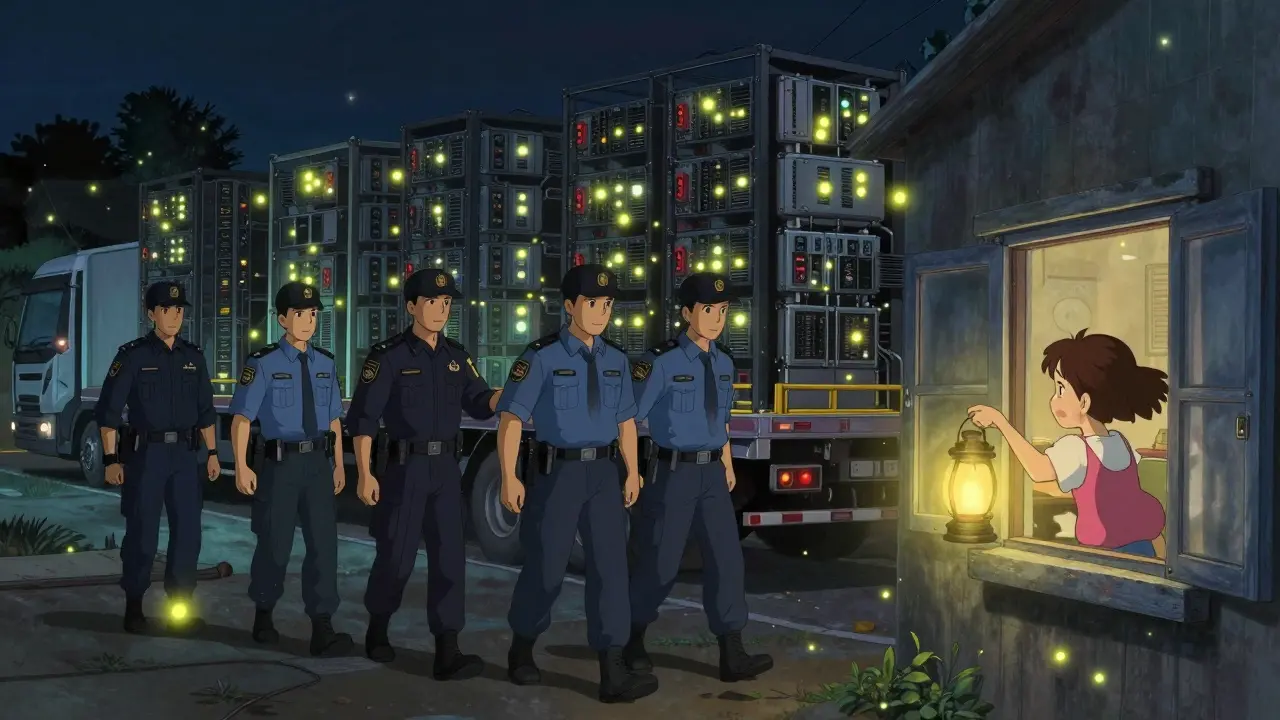
In August 2024, Angolan authorities teamed up with Interpol for a massive crackdown. They raided 25 illegal mining facilities. All of them were run by Chinese nationals. Over 60 people were arrested. Equipment worth more than $37 million was seized - enough to power entire towns.
The Chinese Embassy had already warned its citizens: stop mining. The law was clear. But many didn’t listen - until the raid. The seized hardware wasn’t destroyed. The government announced it would be redistributed to hospitals, schools, and communities hit hardest by blackouts. It was a powerful message: we’re not just banning mining. We’re taking back what was stolen.
This wasn’t an isolated event. It was part of a continent-wide operation. Across Africa, over 1,200 people were arrested, and more than $97 million in crypto-related assets were recovered. Zambia, for example, shut down a fraud scheme that tricked 65,000 people into losing $300 million through fake crypto investment promises.
Where Did the Miners Come From?
Angola didn’t become a mining hotspot by accident. It happened because China banned crypto mining in 2021. When China shut down its mines, thousands of operators packed up their rigs and looked for cheaper power. Angola had it: abundant hydroelectric capacity, lax enforcement, and low electricity costs for industrial users.
By 2023, Angola was the 8th largest Bitcoin mining country in the world - ahead of countries like the UK and Canada. It was the top mining hub in Africa. But it wasn’t sustainable. The country’s power infrastructure was never built to handle this kind of load. Residential areas were suffering. Businesses were shutting down. The government realized it had become a victim of its own resources.

Legal Loopholes and Enforcement Issues
Even with the ban, there are cracks in the law. Legal experts from CMS Law Firm noticed a technical error in how penalties are written for corporate entities. The article numbers don’t match up. That could cause delays or confusion in court cases.
Also, the law doesn’t ban owning cryptocurrency. You can still hold Bitcoin or Ethereum. You just can’t mine it. You can’t use Angolan power to generate it. You can’t set up a farm. But if you bought crypto on a foreign exchange and stored it in a wallet? That’s still legal.
Still, the ban has sent shockwaves through the global mining industry. Before April 2024, Angola contributed about 1.5% of the total Bitcoin network hash rate. That’s gone. Miners have scattered - to Kazakhstan, Paraguay, and even back to underground operations in Nigeria. The global mining landscape shifted overnight.
What This Means for the Future
Angola’s move wasn’t just about energy. It was a statement: national infrastructure comes before global speculation. The government made it clear that citizens’ access to power is non-negotiable.
Other African nations are watching closely. Nigeria, Kenya, and Egypt have all struggled with crypto mining’s impact on their grids. Some have started imposing restrictions. Others are considering outright bans. Angola’s case is now a blueprint - for how to act fast, enforce hard, and reclaim public resources.
For miners? The message is simple: if you’re using someone else’s power to make money, you’re stealing. And if that country decides to fight back - you will lose.
For everyday Angolans? The lights are coming back on. Slowly. But they’re coming.
Is cryptocurrency mining still legal in Angola as of 2026?
No. The ban under Law No. 3/24, which took effect on April 10, 2024, remains fully in force. There have been no amendments, repeals, or suspensions. Mining, even with private generators, is still illegal. Possession of mining equipment is also a criminal offense.
Can I still own Bitcoin in Angola after the ban?
Yes. The ban only targets mining and the use of national power infrastructure. You can still buy, sell, hold, or transfer Bitcoin and other cryptocurrencies using foreign exchanges. But you cannot mine it, and you cannot use Angolan electricity to support any mining activity - even from home.
What happens if I’m caught mining in Angola?
If you’re caught mining, you face imprisonment from one to twelve years, depending on the scale of your operation. Your equipment will be seized and destroyed or redistributed. Foreign nationals may be deported. Even possessing mining gear without proof of legal use can lead to one to five years in jail. There are no fines - only prison and asset forfeiture.
Why did Interpol get involved in Angola’s crypto crackdown?
Interpol got involved because the mining operations were largely run by foreign nationals - mostly Chinese - and involved cross-border criminal networks. The scale of the seizure - over $37 million in equipment - and the link to energy theft made it an international crime issue. The operation was part of a broader African cybercrime initiative targeting illegal crypto mining and fraud.
Did Angola’s ban affect the global Bitcoin network?
Yes. Before the ban, Angola contributed about 1.5% of Bitcoin’s total network hash rate - making it one of the top 10 mining countries globally. After the ban, that capacity vanished overnight. While the network adjusted without major disruption, it did reduce global mining diversity, pushing more activity toward a few dominant regions like the U.S., Canada, and Kazakhstan.
Are there any legal ways to mine crypto in Angola now?
No. There are no exceptions. Even if you use solar panels, diesel generators, or private power sources, connecting any mining equipment to the national grid is illegal - and even off-grid mining is considered a violation under the law. The government has not issued any permits or licenses for mining under any conditions.




Elizabeth Choe
February 11, 2026 AT 02:55Crystal McCoun
February 12, 2026 AT 01:23Elijah Young
February 13, 2026 AT 09:37Beth Trittschuh
February 13, 2026 AT 23:06Benjamin Andrew
February 14, 2026 AT 04:18Holly Perkins
February 15, 2026 AT 03:15Will Lum
February 16, 2026 AT 22:20Sanchita Nahar
February 18, 2026 AT 12:52Ben Pintilie
February 19, 2026 AT 08:55Sakshi Arora
February 19, 2026 AT 22:08Desiree Foo
February 21, 2026 AT 03:19Kaz Selbie
February 21, 2026 AT 07:08