You send $50 to a disaster relief fund. Two weeks later, you see a press release about the aid arriving. But did your specific $50 buy that tent? Or did it pay for an office printer in a capital city three thousand miles away? For decades, this question has haunted donors. We trust charities with our money, but we rarely see where it actually goes. This opacity breeds skepticism. Enter blockchain, a distributed ledger technology that records transactions across many computers so that the record cannot be altered retroactively without the alteration of all subsequent blocks and the consensus of the network. It promises to turn charitable giving from a leap of faith into a verifiable audit trail.
This isn't just theoretical hype. Platforms like DonateBlocks and real-world applications by LUXARITY are already using this tech to track every cent. If you're a donor tired of vague impact reports, or a nonprofit leader drowning in administrative overhead, understanding how blockchain reshapes philanthropy is no longer optional-it's essential for survival in a trust-deficit economy.
The Trust Deficit in Traditional Philanthropy
Traditional charity models suffer from a fundamental flaw: information asymmetry. The organization knows exactly where the money goes; the donor guesses. This gap creates friction. Studies consistently show that donor retention drops when transparency fails. When you can't trace your contribution, you assume the worst-administrative bloat, misallocation, or outright fraud.
Consider the lifecycle of a standard donation. You click "Donate." The money hits a bank account. It sits there, mixed with thousands of other contributions. Months later, the charity allocates funds based on internal budgets. There is no direct link between your transaction ID and the specific meal served or vaccine administered. Intermediaries-banks, payment processors, and sometimes third-party auditors-add cost and delay. Each step introduces potential error and opacity. Blockchain removes these middlemen. By recording the donation on an immutable ledger, the system provides a single source of truth accessible to everyone, instantly.
How Smart Contracts Automate Accountability
The engine behind blockchain charity isn't just the ledger; it's the smart contract. A self-executing contract with the terms of the agreement directly written into lines of code that automatically executes when predetermined conditions are met. Think of a smart contract as a digital escrow agent that never sleeps and never lies. In a platform like DonateBlocks, built on the Ethereum network, two types of contracts govern the process.
First, the DonationEvent contract. This is created by the campaign organizer. It defines the rules: the goal amount, the deadline, and the recipient organization. Second, the DonationTracking contract. This acts as the public ledger for that specific cause. When you donate, you aren't just sending money; you're interacting with these contracts. The code ensures that funds are only released if the minimum threshold is met by the deadline. If the goal isn't reached, the smart contract automatically refunds the donors. No manual processing, no waiting for checks, no "we'll get back to you" emails.
| Feature | Traditional System | Blockchain System |
|---|---|---|
| Traceability | Low (Aggregate reporting) | High (Transaction-level tracking) |
| Speed | Days to Weeks | Minutes to Hours |
| Cost | High (Bank fees, admin costs) | Lower (Network fees, automated admin) |
| Trust Mechanism | Institutional Reputation | Cryptographic Verification |
| Data Integrity | Editable Database | Immutable Ledger |
Real-World Implementation: The DonateBlocks Model
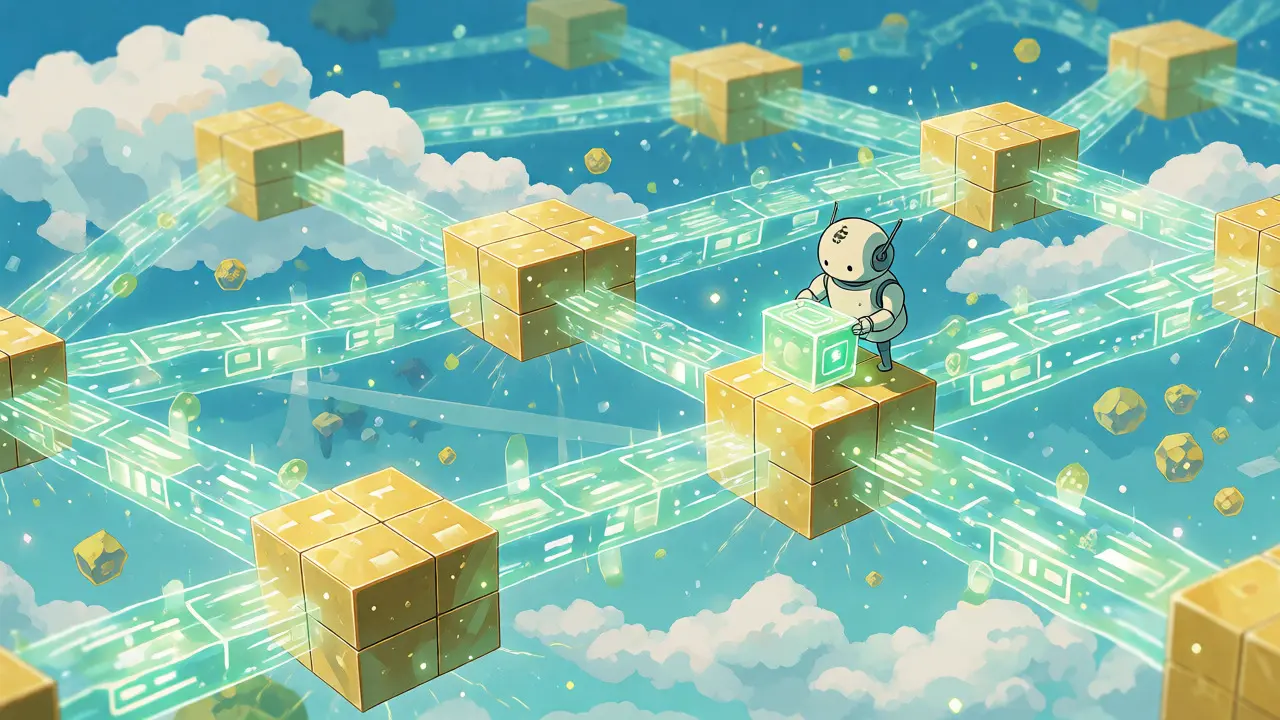
Let's look at how this works in practice. The DonateBlocks platform illustrates the architecture clearly. It uses Solidity, the programming language for Ethereum, to compile contracts into EVM bytecode. These are deployed to the blockchain via contract address transactions. For a donor, the interface might look simple-a button that says "Donate." But behind the scenes, eight core functions are firing.
- Registration & Identity: Users verify their identity through decentralized mechanisms, often involving document authentication and email verification, ensuring that while transactions are pseudonymous, the actors are accountable.
- Fund Donation: You select a charity project and recharge your account using virtual tokens or cryptocurrency. The smart contract locks these funds.
- Material Management: This is crucial for physical goods. The system tracks procurement, transportation, deployment, and distribution. If a charity buys medical supplies, the blockchain records the purchase, the shipment, and the final delivery receipt.
- Feedback Loop: Once the project completes, beneficiaries or organizers upload proof. The donor receives a notification. You can query the historical record to see exactly when and how your contribution was utilized.
This level of granularity solves the "black box" problem. You don't just know that $1 million was raised; you know that $50 of your money bought a specific crate of antibiotics that arrived on November 3rd.
Enhancing Engagement with NFTs
Transparency alone doesn't always motivate repeat giving. That's where Non-Fungible Tokens (NFTs) come in. Modern platforms integrate NFT rewards to make philanthropy interactive. When you donate, you might receive a unique digital collectible representing your contribution. Unlike a generic tax receipt, this NFT lives in your digital wallet (like MetaMask). It serves as a permanent, verifiable badge of honor.
For example, LUXARITY’s luxury goods donation tracking system allows consumers to allocate purchases to causes. A portion of the sale proceeds goes to charity, tracked on-chain. The donor gets a report detailing their contribution percentage and total grant amounts. This gamification turns passive giving into active participation. Donors feel a sense of ownership and pride, which increases retention rates significantly compared to traditional one-off cash gifts.

Overcoming Technical Barriers for Nonprofits
If you run a small nonprofit, the phrase "deploying smart contracts" probably sounds terrifying. It shouldn't be. The learning curve exists, but tools are maturing fast. You need three things: technical expertise in Solidity (or a partner who has it), integration with payment processors (like Shopify for fiat conversion), and a strategy for user education.
Most donors won't manage private keys. They want to use credit cards. Therefore, successful implementations often use hybrid models. The backend runs on blockchain for transparency, but the frontend abstracts the crypto complexity. Organizations must also budget for smart contract auditing. Since code is law, a bug in the contract means lost funds. Rigorous security verification is non-negotiable.
Furthermore, consider the environmental impact. While Ethereum moved to Proof-of-Stake, reducing energy consumption by over 99%, other blockchains vary. Choosing a green chain aligns with the ethical values of most charitable organizations. It prevents the irony of saving the planet while burning coal to do it.
The Future of Verifiable Giving
We are moving toward a world where cross-border donations happen in seconds, not weeks. Regulatory compliance is becoming easier as blockchain provides inherent audit trails for governments. Imagine a scenario where international aid is sent during a crisis. Instead of wire transfers taking days and getting stuck in compliance checks, stablecoins move instantly. Recipients convert them to local currency immediately. The entire flow-from donor's wallet to beneficiary's phone-is visible on a public dashboard.
This technology doesn't replace human empathy; it amplifies it by removing doubt. When donors trust the system, they give more. When nonprofits prove their efficiency, they attract more talent and funding. It’s a virtuous cycle driven by data, not just goodwill.
Is blockchain charity only for cryptocurrency users?
No. Most modern platforms allow users to donate via credit card or bank transfer. The system converts these fiat currencies into digital assets or records the transaction on-chain behind the scenes. The donor experience remains familiar, while the backend leverages blockchain for transparency.
Can my personal data be seen on the blockchain?
Generally, no. Transactions are recorded using cryptographic addresses (public keys), not names. Your identity is linked to your wallet off-chain through secure, encrypted databases. This maintains privacy while ensuring accountability.
What happens if the charity misuses the funds despite the blockchain?
Smart contracts can restrict fund usage. For instance, funds can be programmed to release only upon verification of specific milestones (e.g., GPS coordinates of delivered goods). If the charity fails to provide proof, the contract can withhold further disbursements or trigger refunds.
Are transaction fees high for small donations?
On major networks like Ethereum, fees can be significant for very small amounts. However, Layer-2 solutions and newer blockchains offer near-zero fees. Many platforms batch transactions or subsidize fees for micro-donations to keep them viable.
Do I need a crypto wallet to donate?
Not necessarily. Many interfaces generate temporary wallets for you or allow direct fiat payments. If you want to claim NFT rewards or track your history long-term, setting up a persistent wallet like MetaMask is recommended but not mandatory for the act of donating itself.