
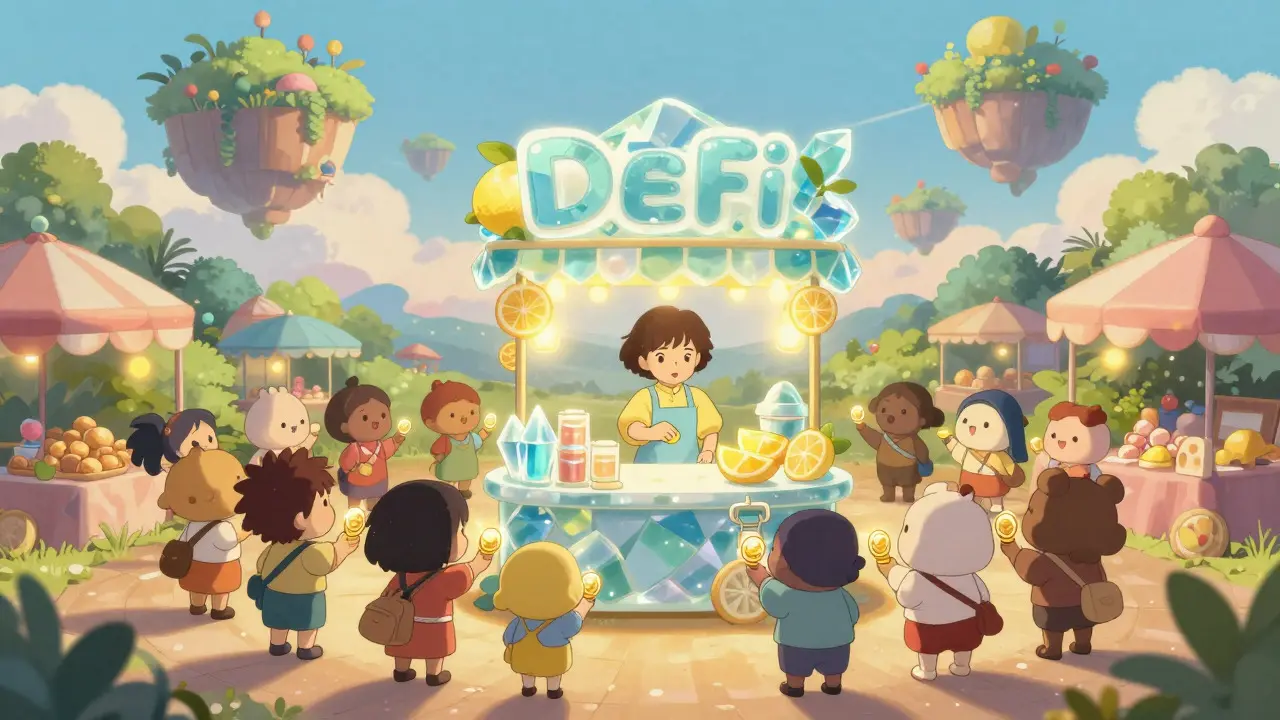
Imagine you open a lemonade stand. You have lemons and sugar, but no customers. To get people to line up, you start handing out free candies to anyone who buys a cup. That is essentially what Liquidity Mining is in the world of decentralized finance. Protocols need your money to function, so they pay you with newly created tokens. This process-known as token emissions-is the engine that has driven billions of dollars into DeFi since 2020.
But here is the catch: those tokens are not just free money. They come with strings attached, risks involved, and complex schedules that can make or break your portfolio. If you do not understand how these emissions work, you might find yourself holding a bag of worthless tokens while your original capital evaporates due to impermanent loss. Let’s break down exactly how this mechanism works, why it exists, and how to navigate it without losing your shirt.
The Chicken-and-Egg Problem in DeFi
New blockchain protocols face a massive hurdle. They need liquidity (money) for users to trade or lend against. But users will not put their money in unless there is already activity and trust. It is a classic chicken-and-egg scenario. Without liquidity, the protocol is useless. Without utility, no one provides liquidity.
Compound Finance solved this in June 2020 by introducing its COMP token. Instead of selling tokens to venture capitalists, they distributed 42% of their total supply directly to users who lent or borrowed on the platform. This was the birth of modern liquidity mining. By incentivizing participation with governance rights and potential future value, Compound bootstrapped its own ecosystem. Since then, Ethereum’s DeFi sector alone has distributed over $12.7 billion in token emissions between 2020 and 2025.
This model shifted the power dynamic. Instead of relying on marketing budgets, protocols now rely on tokenomics-the economic design of their currency-to attract capital. The goal is simple: use inflationary pressure to create demand for the protocol itself.
How Token Emissions Actually Work
You might think emission schedules are straightforward, but they vary wildly. Understanding the technical structure is crucial because it dictates when you should enter and exit a position. Most emissions operate through smart contracts that release tokens at set intervals, usually per block or daily.
There are three main types of emission structures you will encounter:
- Linear Vesting: Tokens are released at a constant rate over a long period. For example, Uniswap initially vested 400 million UNI tokens over four years. This creates predictable, steady rewards but less urgency for early adopters.
- Decay Curves: The reward rate drops over time to encourage early entry. SushiSwap famously halved its emissions every two weeks. This creates a "gold rush" effect where liquidity floods in early and drains quickly as yields drop.
- Zone-Based Reductions: More complex models like EarnPark’s K(z) system reduce emissions across different zones as the protocol matures. This aims to smooth out the transition from high-incentive bootstrap phases to sustainable operations.
- Analyze the Tokenomics: Check the total supply, initial circulation, and team vesting schedules. High insider allocation (>25%) often leads to heavy sell pressure later.
- Calculate Net Yield: Subtract estimated impermanent loss from the emission APR. If the number is negative or near zero, skip it.
- Diversify Exposure: Limit any single protocol to 5-15% of your portfolio. Messari’s 2025 DeFi Handbook recommends this cap to mitigate smart contract and regulatory risks.
- Monitor Emission Schedules: Use tools like Token Unlocks to track when large batches of tokens hit the market. Pre-sell positions before major unlocks to avoid dilution.
- Prefer VeModels: Where possible, choose protocols with lock-up mechanisms. They tend to have stickier liquidity and better long-term price action.
When evaluating a pool, look at the Annual Percentage Rate (APR). During initial launches, APRs can skyrocket to over 1,000%. However, these numbers are often misleading. A 1,000% APR on a volatile token means little if that token loses 90% of its value in a month. Always calculate the effective yield based on the underlying asset stability.

The Hidden Cost: Impermanent Loss vs. Emission Yield
This is where most beginners lose money. When you provide liquidity to an Automated Market Maker (AMM), you expose yourself to Impermanent Loss. This occurs when the price of your deposited assets changes relative to each other. The AMM rebalances your holdings, leaving you with fewer valuable assets and more cheap ones compared to just holding them in your wallet.
For stablecoin pairs, impermanent loss is low (typically 5-15%). But for volatile pairs like ETH/USDC, it can range from 20-50% during significant price swings. Your token emissions must outweigh this loss to be profitable.
Let’s say you deposit $10,000 into a volatile pair. If the price moves 20%, you might suffer $2,000 in impermanent loss. If your emission yield only generates $500 in new tokens, you are net negative. Successful liquidity miners track this metric closely. Tools like Gauntlet Networks simulate these scenarios, showing that well-designed emission schedules retain 70-85% of providers, while poorly structured ones see mass exodus once the math turns sour.
VeTokenomics: Aligning Incentives Long-Term
Early liquidity mining suffered from "mercenary capital." Users would farm high yields for a few days, dump the tokens, and leave, causing death spirals for protocols. To fix this, developers introduced veTokenomics, popularized by Curve Finance.
In this model, you lock your governance tokens for a set period (often up to four years) to receive boosted emissions. The longer you lock, the higher your share of the rewards. This aligns user interests with the protocol’s long-term health. According to Delphi Digital’s Q1 2025 research, protocols using veTokenomics show 32% higher liquidity retention and 27% more stable token prices compared to standard models.
Yearn Finance’s yveCRV model is a prime example. By offering 40-60% APY with vote-escrowed emissions, it created genuine alignment. Users weren’t just dumping tokens; they were staking them to influence governance and capture fees. This shift from short-term speculation to long-term ownership is critical for sustainability.
| Model Type | Emission Structure | Risk Profile | Best For |
|---|---|---|---|
| Standard Linear | Fixed rate over time | Moderate | Stable, mature protocols |
| Decay Curve | Rewards decrease rapidly | High (Mercenary Capital) | New protocol bootstrapping |
| VeTokenomics | Lock-up required for boosts | Low-Medium (Long-term) | Governance-aligned investors |

Regulatory Risks and Future Trends
The landscape is changing fast. Regulatory bodies are scrutinizing emission models. In August 2024, the SEC targeted YieldYield Protocol, classifying certain emission structures as unregistered securities. The EU’s MiCA framework, effective January 2025, now requires detailed disclosure of emission schedules in whitepapers. This adds compliance costs but also brings legitimacy.
Looking ahead, the trend is shifting toward "value-capture mechanisms." Instead of pure inflation, successful protocols aim for revenue-to-emission ratios above 0.5. This means for every dollar emitted in rewards, the protocol generates at least 50 cents in actual fees. Only 12% of top 100 protocols currently meet this threshold, according to Electric Capital’s 2025 report.
Innovations like Pendle Finance’s yield tokenization allow traders to buy and sell future emission streams. This separates the risk of the underlying asset from the yield, creating a more sophisticated market. Layer 2 solutions like Arbitrum are also reducing gas costs by 87%, making small-scale liquidity provision viable for retail users.
Practical Steps for Safe Participation
If you want to participate in liquidity mining, follow these steps to protect your capital:
Remember, liquidity mining is not passive income. It requires active management. The era of mindless "click and earn" is over. Today’s successful farmers treat it like a trading strategy, balancing yield generation with capital preservation.
What is the biggest risk in liquidity mining?
The biggest risk is impermanent loss combined with token devaluation. If the emission token crashes in price and your underlying assets suffer from price divergence, you can lose both your principal and your rewards.
Are liquidity mining rewards taxable?
In most jurisdictions, yes. Received tokens are typically taxed as ordinary income at fair market value on the day of receipt. Consult a local tax professional for specific advice.
How do I calculate impermanent loss?
You can use online calculators provided by platforms like CoinGecko or DeFi Llama. Input your initial deposit amount and current prices to see the percentage loss compared to holding.
Is veTokenomics safe?
It reduces mercenary capital risk but introduces lock-up risk. If the protocol fails, your locked tokens may become illiquid or worthless for the duration of the lock.
Which protocols have the best emission models?
Protocols like Curve, Uniswap, and Aave are considered leaders due to their established track records, transparent governance, and balanced emission schedules that prioritize sustainability over hype.






Jessie Smith
July 26, 2026 AT 09:09the whole concept of liquidity mining is just a glorified ponzi scheme dressed up in blockchain jargon to make it palatable for the masses. you are essentially subsidizing early adopters with money that doesn't exist yet, hoping they stay long enough for the token to have value. it is economic alchemy at its finest.
Drew M
July 26, 2026 AT 22:03Oh wow, this is such a deep dive! 🌟 I love how you explained the chicken-and-egg problem. It really makes sense why protocols need to bribe people with tokens. The part about impermanent loss was scary though 😱 but the veTokenomics section gave me hope! Long term thinking is key! 🚀💎
Eric Braddock
July 27, 2026 AT 23:56you think the SEC is regulating this? please. the regulators are asleep at the wheel while the real elites drain the liquidity pools through sophisticated MEV bots and front-running algorithms before you even see the transaction on your screen. the emission schedules are manipulated by insiders who know exactly when the decay curves will hit bottom. it is all rigged from day one.
Nick G
July 28, 2026 AT 11:39I find it fascinating how different cultures approach risk in these decentralized systems. In my experience working with international teams, there is a distinct difference in how Asian markets versus European markets view the volatility of these emission tokens. Perhaps we should look more closely at how global perspectives can inform better risk management strategies for liquidity providers across borders.
Nick Wengel
July 29, 2026 AT 19:59good info thanks for sharing
Alicia Hull
July 30, 2026 AT 03:01This article completely ignores the systemic bias against retail investors. You say 'analyze the tokenomics' as if an average person has access to the same data as venture capitalists. It is grossly unfair that institutions get first dibs on high-yield pools while we are left chasing scraps after the initial dump. Where is the accountability?
Johan Otto
July 31, 2026 AT 22:46boring stuff honestly. everyone knows how it works. just buy low sell high and stop overthinking the mechanics. drama queen much? lol
Tracy Marshall
August 2, 2026 AT 22:36it is obvious that these protocols are designed to exploit the greed of humanity. the moral decay is evident in every whitepaper i read. they promise wealth but deliver debt. trust no one. the system is corrupt :-(
Guy Davis
August 3, 2026 AT 01:20typical woke crypto nonsense. u guys are gonna lose everything because u dont follow the rules. simple as that. stop being stupid.
KEITH WONG
August 3, 2026 AT 18:57listen up peasants. if u cant handle the math u dont deserve the yield. most of u are too dumb to calculate impermanent loss so u end up holding the bag. learn or leave. 🤡📉
Natalie Lucas
August 5, 2026 AT 16:49i tried farming once and got rekt hard lol. but hey at least i learned something right? vibes were good though. keep grinding yall 💪✨
Curtis Johnson
August 7, 2026 AT 00:53let us not forget that community support is vital here. many of us feel overwhelmed by the complexity but together we can navigate these waters. it is important to share knowledge without judgment. perhaps we can create a safer space for new learners to ask questions without fear of ridicule. let us lift each other up 🙏
Steven Briggs
August 7, 2026 AT 05:32quietly reading this. seems accurate. im watching from the sidelines for now. maybe later.