

Imagine trying to find a specific conversation in a library where every book is written on one long scroll of paper, with no table of contents and no page numbers. You’d have to read every single word from the beginning until you found what you needed. That’s exactly how blockchains work by default. They are append-only ledgers-great for security, terrible for searching.
This is where The Graph comes in. It isn’t just another cryptocurrency; it’s the search engine for blockchain data. If Ethereum is the computer, The Graph is the operating system that lets applications actually use the data stored on it. Without The Graph, building a decentralized app (dApp) that needs to look up historical transaction history would require developers to write custom code to scan millions of blocks manually-a slow, expensive nightmare.
The Core Problem: Why Blockchains Need Indexing
Blockchains like Ethereum are designed to be immutable and secure, not fast at retrieval. When you want to know "How many NFTs did Alice buy last month?" or "What was the total volume of this DEX pool in Q3?", you can't just run a simple SQL query. The raw data is scattered across thousands of transactions and events.
Before The Graph, developers had two bad options:
- Build their own indexer: Write custom software to watch the blockchain, process every event, and store it in a traditional database. This requires constant maintenance, server costs, and handling complex issues like chain reorganizations (when the blockchain temporarily forks).
- Use centralized APIs: Services like Infura or Alchemy help, but they are centralized points of failure. If their servers go down, your dApp breaks. Plus, they often lack deep historical query capabilities without heavy configuration.
The Graph solves this by creating a decentralized network of computers (called Indexers) that specialize in organizing this data into structured formats called Subgraphs. These Subgraphs expose the data via GraphQL, a standard query language that makes fetching data as easy as asking a question.
How The Graph Works: The Four Key Players
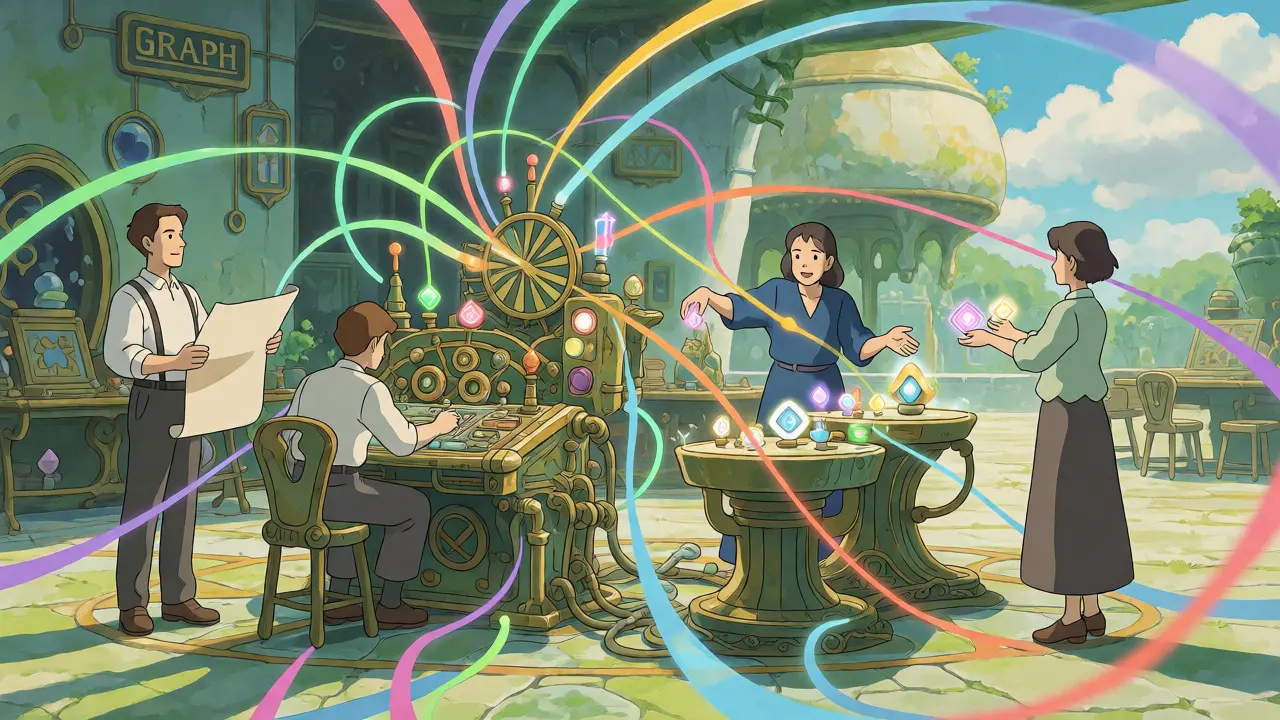
The Graph isn’t controlled by one company. It’s a marketplace where different participants interact using the GRT token. Think of it as an economy for data services. There are four main roles you need to understand:
1. Developers
These are the builders. They create Subgraphs, which are essentially blueprints that tell the network what data to index and how to structure it. For example, a developer might build a Subgraph specifically for Uniswap liquidity pools. Once deployed, anyone can query this Subgraph.
2. Indexers
Indexers are the service providers. They run nodes (servers) that sync with the blockchain, process the data according to the Subgraph specifications, and answer queries. To participate, Indexers must stake GRT. If they provide good service, they earn rewards. If they act maliciously or fail to serve queries accurately, they can lose part of their stake (slashing).
3. Curators
With thousands of potential Subgraphs, how do Indexers know which ones are worth indexing? Enter Curators. Curators signal quality by staking GRT on specific Subgraphs. High curation signals attract more Indexers because those Subgraphs will likely generate more query fees. Curators earn a portion of the indexing rewards generated by the Subgraphs they signal.
4. Delegators
Not everyone has the technical skills or hardware to run an Indexer node. Delegators hold GRT and delegate it to trusted Indexers. In return, they receive a share of the Indexer’s rewards, minus a fee cut taken by the Indexer. This allows ordinary token holders to participate in the network’s security and profitability without running infrastructure.
| Role | Main Function | Risk/Reward |
|---|---|---|
| Developer | Creates and deploys Subgraphs | Pays for queries; benefits from accurate data |
| Indexer | Runs nodes, indexes data, answers queries | Earns query fees + rewards; risk of slashing |
| Curator | Signals high-quality Subgraphs with GRT | Earns share of indexing rewards; risk if Subgraph fails |
| Delegator | Stakes GRT with Indexers | Earns passive income; depends on Indexer performance |
Understanding Subgraphs and GraphQL
You’ve heard the term Subgraph, but what is it technically? A Subgraph is a set of instructions written in AssemblyScript (a variant of JavaScript) that defines:
- Data Sources: Which smart contracts to watch.
- Entities: How to structure the data (e.g., "User," "Transaction," "Pool").
- Mappings: Logic to transform raw blockchain events into these entities.
Once indexed, the data is accessible via GraphQL. If you’re familiar with web development, you’ll appreciate how powerful this is. Instead of making ten separate API calls to get user balances, transaction history, and NFT holdings, you can make one precise GraphQL query to The Graph and get everything back in a clean JSON format.
For instance, querying for all swaps on a specific DEX pair becomes trivial. You don’t need to know the internal mechanics of the smart contract; you just ask the Subgraph for "SwapEvents" within a certain time range.
The Economics of GRT: Tokenomics and Staking
The Graph Token (GRT) is an ERC-20 utility token. It’s not just a speculative asset; it’s the fuel that powers the network. Its primary functions are:
- Staking: Indexers and Delegators lock GRT to secure the network.
- Curation: Curators stake GRT to signal valuable Subgraphs.
- Governance: Holders can vote on protocol upgrades and treasury management through The Graph Foundation.
Is GRT inflationary? Yes, but with a burn mechanism. The protocol issues new GRT annually (historically around 2-3%) to pay Indexers. However, a portion of query fees paid by consumers is burned. This creates a dynamic supply model intended to balance incentives. As of late 2026, circulating supply hovers around 10.9 billion tokens, though prices fluctuate wildly based on broader market conditions.
If you’re considering delegating your GRT, keep in mind that returns depend on:
- Query Volume: More queries mean more fees for Indexers.
- Indexer Efficiency: Good Indexers optimize their operations to maximize profit.
- Fee Cuts: Indexers take a percentage of rewards before distributing them to Delegators. Typical cuts range from 7% to 12%.
Competitors and Alternatives
The Graph isn’t alone in the data indexing space. Newer competitors have emerged, each offering different trade-offs. Here’s how they stack up:
| Protocol | Key Feature | Best For |
|---|---|---|
| The Graph | Decentralized, mature ecosystem, GraphQL | dApps needing permissionless, decentralized data access |
| Goldsky | Real-time streaming, managed infrastructure | Applications requiring low-latency data feeds |
| Envio | Ultra-fast syncing, Ponder framework | Developers prioritizing speed and ease of deployment |
| Subsquid | Multi-chain support, SQL & GraphQL access | Complex analytics across many blockchains |
The Graph’s main advantage is its decentralization and established reputation. While Goldsky or Envio might offer faster setup times or better real-time performance, The Graph provides a censorship-resistant layer that aligns with Web3 values. If your dApp relies on trustlessness, The Graph remains the gold standard.
Who Should Use The Graph?
You don’t need to be a crypto expert to benefit from The Graph, but you do need to identify if your project fits its niche.
For Developers
If you’re building a DeFi dashboard, an NFT marketplace, or a DAO governance tool, The Graph saves you hundreds of hours of backend engineering. You focus on the frontend logic while The Graph handles the heavy lifting of data extraction.
For Investors
Holding GRT gives you exposure to the growth of decentralized infrastructure. As more dApps launch and demand for data increases, the utility of GRT rises. However, be aware that token value doesn’t always correlate directly with usage due to competition and macro-economic factors.
For Data Analysts
Accessing raw blockchain data is painful. The Graph’s endpoints allow analysts to pull structured data for research without running their own nodes. Many academic papers and financial reports now rely on The Graph’s data.
Challenges and Risks
No technology is perfect. The Graph faces several hurdles:
- Centralization Concerns: A small number of large Indexers control a significant portion of the staked GRT. This could lead to collusion or reduced resilience.
- Value Accrual: Critics argue that dApps can use The Graph without necessarily driving up the price of GRT significantly, especially if they use centralized alternatives.
- Technical Complexity: Writing efficient Subgraphs requires knowledge of AssemblyScript and blockchain internals. Poorly optimized Subgraphs can be expensive to query.
Additionally, the network is evolving. Recent updates have introduced gateway-mediated pricing and new payment models, moving away from pure query-fee markets toward subscription-like structures. Keeping up with these changes is crucial for long-term users.
Final Thoughts
The Graph is the plumbing of the decentralized web. You might not see it, but it’s essential for keeping the lights on in countless dApps. Whether you’re a developer looking to ship faster, an investor betting on infrastructure growth, or a curious observer, understanding GRT helps you grasp how modern blockchains actually deliver usable information.
As we move further into 2026, the focus shifts from just "indexing" to providing comprehensive data services, including streaming and cross-chain analytics. The Graph’s ability to adapt while maintaining decentralization will determine its future success.
Is The Graph a Layer 1 blockchain?
No, The Graph is not a Layer 1 blockchain like Ethereum or Solana. It is a protocol that runs on top of existing blockchains. It indexes data from multiple chains (including Ethereum, Polygon, Arbitrum, and others) and serves it via its own decentralized network. The GRT token is currently an ERC-20 token on Ethereum, though plans exist to migrate it to a native L1 chain in the future.
Can I mine GRT?
You cannot "mine" GRT in the traditional Proof-of-Work sense (like Bitcoin). Instead, you earn GRT by participating in the network. Indexers earn rewards for serving queries, Curators earn rewards for signaling quality, and Delegators earn a share of Indexer rewards. This is often referred to as "staking" rather than mining.
What happens if an Indexer goes offline?
If an Indexer goes offline, it stops earning query fees and may miss out on indexing rewards. However, it generally does not face slashing penalties for downtime alone unless it fails to respond to challenges or submits invalid proofs. The network is designed so that other Indexers can pick up the slack, ensuring data availability continues.
Do I need to hold GRT to use The Graph as a developer?
Initially, developers used a free hosted service. Now, most production-grade deployments require paying query fees, which are settled in GRT (or stablecoins via gateways). While you don’t strictly need to hold GRT to write Subgraphs, you or your users will eventually need to pay for the data consumption, often involving GRT economics indirectly.
How is The Graph different from Chainlink?
Chainlink is primarily an oracle network that brings external off-chain data (like stock prices or weather) onto the blockchain. The Graph is an indexing protocol that organizes on-chain data already present on the blockchain. Chainlink pushes data into smart contracts; The Graph pulls and structures data for applications to read.