
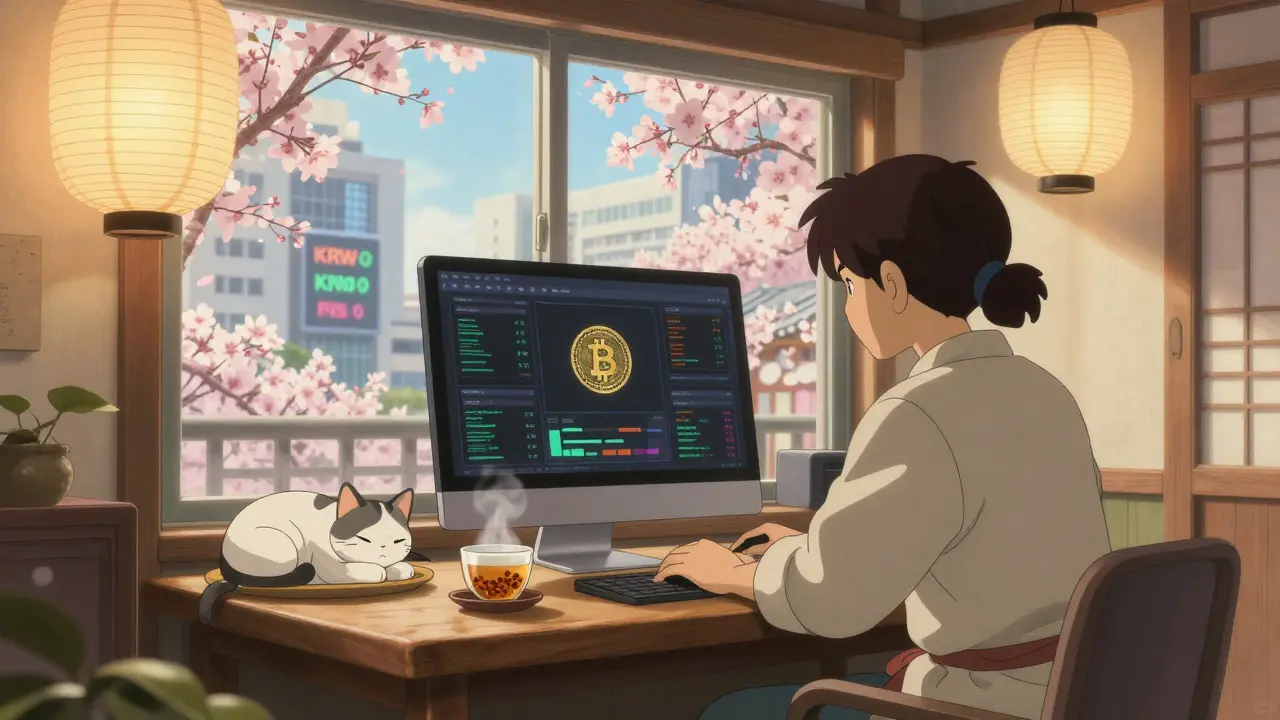
When you’re trading crypto in South Korea, you don’t just want any exchange-you want one that plays by the country’s strict rules, speaks your language, and doesn’t vanish overnight. That’s where COREDAX comes in. It’s not Binance. It’s not Coinbase. It’s a Korean exchange built for Korean traders, with all the perks and limits that come with it.
What Is COREDAX?
COREDAX is a cryptocurrency exchange founded in 2020 and headquartered in South Korea. It’s not trying to be global. It’s not chasing millions of users from every country. It’s focused on one thing: serving the Korean retail market with a platform that meets the country’s tough regulatory standards. As of 2025, it’s the 4th largest crypto exchange in South Korea, handling about 6.2% of the country’s daily $3.2 billion trading volume.
Unlike offshore exchanges that operate in legal gray zones, COREDAX is fully licensed under South Korea’s Virtual Asset User Protection Act, which kicked in July 2023. That means they must keep 90% of customer funds insured, undergo regular proof-of-reserves audits, and enforce strict KYC checks. If you’re worried about scams or sudden platform shutdowns, this matters.
Supported Cryptocurrencies and Trading Pairs
COREDAX lists 47 cryptocurrencies as of September 2025. That’s not even close to Binance’s 600+ or Coinbase’s 240+. But you won’t find a bunch of random tokens either. The selection is tight: Bitcoin, Ethereum, Solana, Cardano, and a few dozen Korean blockchain projects like Klaytn and NEAR Protocol. If you’re trading mainstream coins or local tokens, you’re covered.
What’s missing? Most altcoins you’ve never heard of. If you’re into memecoins or tiny DeFi tokens, you’ll need another exchange. COREDAX doesn’t list Shiba Inu, Dogecoin, or Solana-based tokens with tiny market caps. It’s not a casino-it’s a regulated trading floor.
Fiat Deposits and Withdrawals: Wire Only
This is where COREDAX draws a hard line. You can’t deposit with a credit card, PayPal, or even a Korean e-wallet like KakaoPay. The only way to add fiat is through bank wire transfer in Korean Won (KRW). Minimum deposit? ₩50,000 ($38 USD). It’s not fast. It takes 1.8 business days on average, compared to 0.5 days at Upbit.
Withdrawals work the same way. You can’t cash out to a card. You get your won sent back to your Korean bank account. For locals, this is normal. For international users? It’s a dealbreaker. If you’re outside Korea and don’t have a Korean bank account, you can’t use COREDAX as a primary exchange.
Trading Platforms: Desktop and Mobile
COREDAX offers both a desktop app and a mobile app. The desktop platform works on Windows 10+ and macOS 11+, with a minimum screen resolution of 1366x768. It’s clean, functional, and built for serious traders. Charts are responsive, order types include limit, market, and stop-loss, and the interface doesn’t overload you with ads or pop-ups.
The mobile app, available on iOS 14+ and Android 8+, has biometric login, real-time price alerts, and push notifications. It’s not perfect-users report lag during high volatility. One Reddit user in r/CryptoKorea said, “It freezes when Bitcoin moves 5% in 10 minutes.” But for most everyday trades, it works fine.
There’s no API documentation publicly available. If you’re a bot trader or use automated strategies, you’re out of luck. COREDAX doesn’t support trading bots or third-party integrations. That’s a big gap compared to Kraken or Binance.

Fees: Competitive, But Not the Lowest
COREDAX charges a flat 0.1% fee for both makers and takers on spot trades. That’s standard. Where it gets interesting is withdrawal fees.
For Bitcoin, you pay 0.001 BTC per withdrawal. That’s higher than Upbit (0.0004 BTC) and Binance (0.0005 BTC). If you’re moving large amounts, that adds up. For Ethereum, it’s 0.01 ETH. For altcoins, fees vary but are usually between 0.5% and 1% of the withdrawal amount.
Deposits are free-except for the time it takes. You’re not paying a fee, but you’re paying in patience.
Security: Regulated, But No Public Audits
COREDAX doesn’t publish its security audit reports. That’s unusual. Most reputable exchanges like Kraken or Coinbase release these. But COREDAX is required by Korean law to follow the Cloud Security Alliance’s guidelines: cold storage for 95%+ of assets, multi-signature wallets, and regular penetration testing.
There have been no public security breaches since its launch in 2020. That’s a good sign. But here’s the catch: North Korean hackers stole over $1.3 billion from exchanges in 2024. No exchange is immune. COREDAX likely uses withdrawal whitelists and IP restrictions-standard for regulated platforms-but we can’t confirm it.
Two-factor authentication (2FA) is mandatory. If you skip it, you can’t trade. That’s a win.
User Experience: Korean-First, International-Second
The app and website are 90% in Korean. The English translation is minimal-just enough to get you registered. If you don’t speak Korean, you’ll struggle. Customer support is 24/7, but response times tell the story: 2.3 minutes for Korean speakers, 18.7 minutes for English speakers.
Registration is a hurdle for foreigners. You need either a Korean resident registration number or a notarized translation of your passport. The process takes 35 to 45 minutes. Many international applicants get rejected because their documents don’t match Korean formatting rules.
On Google Play, the app has a 4.1/5 rating from 1,247 reviews. Positive reviews praise the Korean interface and fast local support. Negative reviews say: “Too few coins,” “Slow deposits,” “No English help.” Trustpilot has zero English reviews. That’s not an accident-it’s by design.

Who Is COREDAX For?
COREDAX is perfect if:
- You live in South Korea
- You want a regulated, safe exchange
- You’re okay with wire transfers and no credit cards
- You trade BTC, ETH, SOL, or Korean blockchain tokens
- You don’t need bots, APIs, or 500+ coins
COREDAX is not for you if:
- You’re outside Korea and don’t have a Korean bank account
- You want to deposit with PayPal, credit cards, or Apple Pay
- You trade small altcoins or memecoins
- You need API access or automated trading
- You expect full English support or a global user interface
How Does COREDAX Compare to Other Korean Exchanges?
In South Korea, the market is dominated by three players: Upbit (52.3%), Bithumb (28.1%), and Korbit (9.7%). COREDAX sits at 6.2%. It’s smaller, but it’s growing.
Upbit and Bithumb offer credit card deposits, faster withdrawals, and more coins. But COREDAX wins on two things: regulatory compliance and user experience for locals. A 2025 Nomura report found that 62% of Korean users prefer COREDAX’s interface because it’s designed for them-not translated from English.
For institutional traders? COREDAX barely registers. Upbit serves 32% of institutional clients. COREDAX? Less than 2%. It’s built for retail, not hedge funds.
Future Outlook: Can COREDAX Survive 2026?
South Korea’s crypto market is shrinking. In 2021, there were 65 exchanges. In 2025, only 14 remain. The government raised the bar: minimum capital of ₩3 billion ($2.3M), mandatory insurance, and real-time transaction monitoring.
COREDAX passed those tests. But the next wave is coming. By 2027, exchanges may need quantum-resistant cryptography. No one’s talking about it yet-but experts say it’s inevitable.
COREDAX’s biggest risk? Staying local. If it doesn’t expand internationally or add payment options, it’ll stay small. If it tries to go global without fixing its language and support issues, it’ll alienate its core users.
Analysts at Mirae Asset Securities give COREDAX a 68% chance of surviving the next 18 months. That’s better than most. But it’s not a guarantee.
Final Verdict
COREDAX isn’t the biggest, fastest, or most feature-rich exchange. But if you’re in South Korea and you care about safety, compliance, and a clean interface in your language, it’s one of the best choices you have.
It’s not for global traders. It’s not for crypto speculators chasing the next memecoin. It’s for Korean retail investors who want to trade securely, without the chaos of offshore platforms.
If you’re local? Try it. If you’re not? Look elsewhere. This exchange isn’t trying to please everyone. It’s trying to serve one market well-and so far, it’s doing just that.
Can I use COREDAX if I’m not from South Korea?
Technically, yes-but it’s not practical. You need a notarized translation of your passport and a Korean bank account to deposit fiat via wire transfer. Most international users get stuck during KYC because document formats don’t match Korean requirements. Without a Korean bank account, you can’t fund your account. COREDAX is built for locals, not global users.
Does COREDAX support credit card deposits?
No. COREDAX does not accept credit cards, debit cards, PayPal, or any e-wallets. The only way to deposit fiat is through bank wire transfer in Korean Won (KRW). This is a major limitation for international users and even some Koreans who prefer instant deposits.
How many cryptocurrencies does COREDAX support?
As of September 2025, COREDAX supports 47 cryptocurrencies. The selection includes major coins like Bitcoin, Ethereum, and Solana, plus a few Korean-specific tokens like Klaytn and NEAR. It does not list memecoins, low-cap altcoins, or newer DeFi projects. If you’re looking for a wide variety of tokens, this exchange won’t satisfy you.
Is COREDAX safe to use?
Yes, for a Korean exchange. COREDAX complies with South Korea’s Virtual Asset User Protection Act, which requires proof-of-reserves audits, 90% asset insurance, and strict KYC. It has no public security breaches since 2020. However, it doesn’t publish third-party security audits, so you’re trusting regulatory enforcement rather than public transparency.
Does COREDAX have an API for trading bots?
No. COREDAX does not offer public API documentation or developer tools. You cannot connect trading bots, automated strategies, or third-party portfolio trackers. This makes it unsuitable for algorithmic traders or advanced users who rely on automation.
What are the withdrawal fees on COREDAX?
COREDAX charges a fixed 0.001 BTC fee for Bitcoin withdrawals. For Ethereum, it’s 0.01 ETH. Altcoin fees vary between 0.5% and 1% of the withdrawn amount. These are higher than Binance and Upbit. Deposits are free, but wire transfers take 1.8 business days on average.
Is COREDAX better than Upbit or Bithumb?
It depends. Upbit and Bithumb offer more coins, faster deposits, and credit card options. But COREDAX has a cleaner interface for Korean speakers, better customer support in Korean, and a stronger reputation for regulatory compliance. If you prioritize ease of use and safety over features, COREDAX is a solid alternative. If you want speed and variety, go with Upbit.
Does COREDAX have an English version?
There’s a partial English translation for basic functions like login and trading, but the entire platform is designed for Korean speakers. Customer support, help articles, and alerts are mostly in Korean. If you don’t read Korean, you’ll struggle with navigation, support, and even understanding fees. It’s not a multilingual platform.
For Korean traders looking for a secure, regulated exchange that feels made for them, COREDAX delivers. For everyone else? Look elsewhere.






Jill McCollum
January 18, 2026 AT 03:22Dustin Secrest
January 18, 2026 AT 23:21Stephen Gaskell
January 19, 2026 AT 06:38Shaun Beckford
January 19, 2026 AT 23:51Pat G
January 20, 2026 AT 05:42Alexandra Heller
January 21, 2026 AT 23:31Bryan Muñoz
January 23, 2026 AT 16:11Rod Petrik
January 23, 2026 AT 22:46Sarah Baker
January 25, 2026 AT 11:27Pramod Sharma
January 26, 2026 AT 15:58Liza Tait-Bailey
January 26, 2026 AT 19:49nathan yeung
January 28, 2026 AT 12:49Bharat Kunduri
January 29, 2026 AT 03:15Chris O'Carroll
January 30, 2026 AT 06:27Christina Shrader
January 31, 2026 AT 06:39Kelly Post
February 2, 2026 AT 00:42Andre Suico
February 2, 2026 AT 08:47