
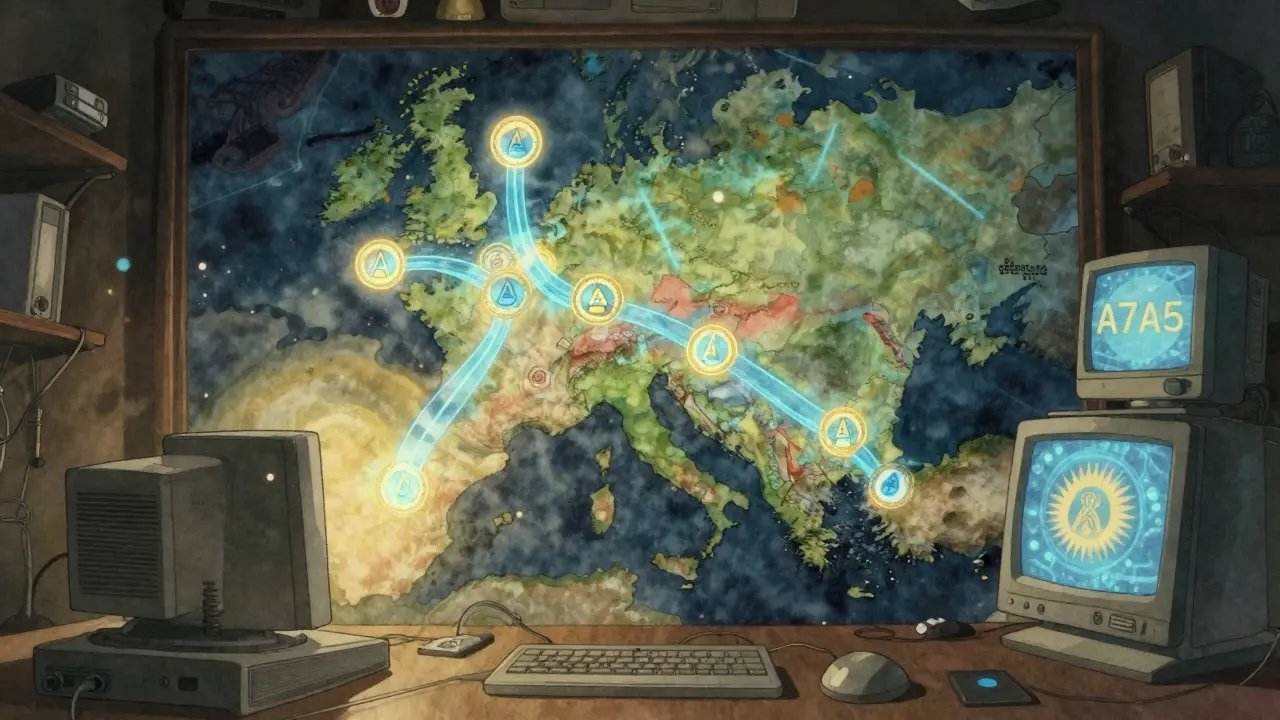
Imagine a financial system that doesn't care about borders, bank freezes, or international law. For a country under heavy economic pressure, that's not a dream-it's a survival strategy. Russia has moved far beyond simple Bitcoin trades; it has built a sophisticated, multi-layered digital shadow economy designed to keep its war machine running and its elites wealthy despite the toughest sanctions in history.
Key Takeaways
- Russia uses custom-built tokens like A7A5 to move billions of dollars through Kyrgyzstan.
- Sanctioned exchanges like Garantex simply rebrand as new entities, such as Grinex, to continue operating.
- Traditional banks in Central Asia act as "gateways," converting crypto back into cash for military procurement.
- International regulators are fighting back with targeted bans on specific crypto-schemes in the EU and UK.
The Rise of the Custom Sanctions-Busting Token
Standard cryptocurrencies like Bitcoin are too volatile and transparent for large-scale state evasion. Instead, Russia has turned to purpose-built assets. Enter A7A5 is a ruble-backed cryptocurrency specifically engineered to bypass Western financial restrictions. Issued by a firm in Kyrgyzstan, this token acts as a bridge, allowing sanctioned rubles to enter the global digital market without triggering red flags in the SWIFT banking system.
The scale here is staggering. In just four months, the A7A5 token processed $9.3 billion in transactions. By launching the token on both the TRON and Ethereum blockchains, the architects ensured that if one network became too restrictive or technically unstable, the money could still flow through another. It's a redundancy strategy that mirrors how military logistics work.
The "Hydra" Strategy: Garantex to Grinex
When the U.S. government shuts down a crypto exchange, they usually expect the business to fold. But Russia treats these exchanges like a Hydra-cut off one head, and two more grow back. A prime example is Garantex, a high-volume exchange originally sanctioned by the U.S. for facilitating illicit Russian financial flows.
After a massive law enforcement crackdown by the U.S. Secret Service on March 6, 2025, Garantex didn't just disappear. Its officers quickly stood up Grinex, a replacement platform designed specifically to absorb Garantex's customer deposits and continue the same prohibited activities. The promotional materials for Grinex were blunt: it existed because of the sanctions. By migrating users and funds to a new brand, the network kept the liquidity flowing, eventually leading the U.S. Treasury's Office of Foreign Assets Control (OFAC) to sanction Grinex as well.
| Original Entity | Replacement/Successor | Primary Purpose | Regulatory Action |
|---|---|---|---|
| Garantex | Grinex / Exved | Ruble-to-Crypto Cash-out | U.S. Treasury (OFAC) Sanctions |
| Traditional Ruble | A7A5 Token | International Liquidity | UK Government Restrictions |
| Standard Banking | Capital Bank (Kyrgyzstan) | Military Procurement | International Monitoring |

The Kyrgyz Gateway and Military Procurement
Crypto is great for moving money, but you can't pay a factory for artillery shells with a digital wallet-at least not easily. This is where the "gateway" comes in. Russia utilizes Capital Bank, a Kyrgyzstani financial institution used to bridge the gap between digital assets and fiat currency for military goods.
Under the direction of Kantemir Chalbayev, this bank allows the Russian state to convert cryptocurrency back into hard cash (fiat). This creates a seamless pipeline: Russian rubles become A7A5 tokens, which are traded for stablecoins on exchanges like Grinex, and are finally converted into usable currency at Capital Bank to buy restricted technology and weaponry. This integration of a traditional bank with a crypto-ecosystem makes the trail incredibly hard for Western intelligence to follow in real-time.
Shadow Networks and Political Influence
The use of crypto isn't just about buying missiles; it's about buying influence. Leaked data from September 2025 involving Ilan Shor, a sanctioned Moldovan politician and ally of the Kremlin, revealed the darker side of these digital wallets. According to analysis by the blockchain forensics firm Elliptic, wallets linked to A7 businesses handled $8 billion in stablecoin transactions over 18 months.
This money didn't just sit there. It funded the infrastructure for apps used to manage and pay networks of political activists in Moldova, effectively importing Russian influence through an untraceable digital pipeline. It proves that Russia sanctions evasion is as much about psychological and political warfare as it is about economics.

How the West is Fighting Back
For years, regulators played catch-up, but 2025 saw a shift in strategy. The European Union's 19th package of sanctions was a game-changer, as it directly targeted "dirty" crypto schemes for the first time. Instead of just sanctioning people, they banned transactions on the specific platforms used to fund the war.
In the UK, the government expanded its list of over 2,700 sanctions to include the infrastructure behind the A7A5 token and exchanges like Meer. Meanwhile, the private sector is stepping up. Companies like Elliptic have integrated A7A5 screening into their compliance tools, meaning that any legitimate business interacting with these tokens will now see a massive red flag on their dashboard.
The Future: A Digital Cat-and-Mouse Game
Is the West winning? Not quite. Analysis from Oxford Analytica suggests that while current crackdowns hurt, Russia is only getting more creative. The move toward "sovereign" digital assets and deeper partnerships with non-aligned nations in Central Asia means the loop will keep closing.
We are entering an era where financial warfare is fought with code. As regulators develop better tracking tools, the evaders will develop more complex obfuscation layers. The real risk is that these methods-custom tokens, shell-bank gateways, and replacement exchanges-provide a blueprint for other sanctioned states or terrorist organizations to follow, further eroding the effectiveness of global financial oversight.
What exactly is the A7A5 token?
A7A5 is a ruble-backed cryptocurrency created to help Russia bypass sanctions. It allows users to move value from the sanctioned Russian ruble into a digital asset that can be traded on the TRON and Ethereum blockchains, making it easier to access international markets.
How did Grinex replace Garantex?
After the U.S. Secret Service took action against Garantex in early 2025, the operators quickly launched Grinex. They transferred customer deposits and services to the new platform to ensure the flow of money wasn't interrupted by the sanctions placed on the original company.
Why is Kyrgyzstan central to this operation?
Kyrgyzstan provides a favorable regulatory environment and financial institutions, like Capital Bank, that are willing to act as intermediaries. These entities serve as the bridge where cryptocurrency is converted back into fiat currency to pay for physical goods.
Can these crypto transactions be traced?
Yes, but it is difficult. While blockchains are public, Russia uses "obfuscation layers"-multiple transfers through different tokens and shell companies. However, firms like Elliptic now use advanced screening to identify A7A5-related wallets.
Are the EU and UK sanctions actually working?
They are increasing the cost and complexity of evasion. By banning specific crypto-platforms and targeting the infrastructure of tokens like A7A5, they force Russia to spend more time and money finding new loopholes, which slows down their procurement process.








Greg Reynolds
April 24, 2026 AT 05:35The notion that these custom tokens are some kind of "sophisticated" breakthrough is laughable. It is basic money laundering with a digital skin. Anyone with a rudimentary understanding of chain analysis knows that once a token is tied to a specific entity, its utility for state-level evasion plummets. They are just playing a game of musical chairs with different brand names to confuse low-level compliance officers.
Benjamin Forg
April 25, 2026 AT 18:02classic deep state psyop right here telling us how the bad guys do it while the real money moves in ways we cant even imagine crypto is just the shiny toy they want us to watch while the globalist cabal erases borders and currency entirely just a distraction for the masses
Tony Gurley-Ward
April 26, 2026 AT 15:23It is a fascinating little dance, isn't it? This whole digital shell game is practically performance art in the realm of geopolitics. We're watching a high-stakes game of hide-and-seek where the seeker is a government bureaucracy and the hider is a ruble-backed token. Absolutely whimsical how they just swap names like they're changing outfits for a gala.
Sarah Fisher
April 28, 2026 AT 03:27This really brings up the philosophical dilemma of decentralization. We were promised a world where money was freed from state control, but here we see the state simply co-opting that freedom to shield itself from accountability. It is a strange paradox where the tool for liberation becomes a tool for survival for an autocracy.
Kyle Bush
April 30, 2026 AT 00:43SICK OF SEEING OUR TAX DOLLARS GOING TO "MONITORING" WHILE THEY JUST FIND NEW WAYS TO CHEAT 😡🇺🇸 WE NEED TO STOP PLAYING DEFENSE AND JUST CRUSH THEM ALL! TOTAL DOMINATION IS THE ONLY WAY! 🦅💥
Clair Geary
April 30, 2026 AT 04:39super interesting how they use those gateway banks in central asia it's like a secret handshake for the global economy the way the money just flows through different shapes and sizes is wild
Lisa Camp
April 30, 2026 AT 17:19GET A GRIP! This is exactly why we need to tighten the screws NOW! No more "monitoring" or "screening"-just shut the whole thing down! Stop being so soft on these regimes and actually do something about the infrastructure! WAKE UP!
Doc Coyle
May 1, 2026 AT 03:50It is simply a matter of basic ethics. Using digital assets to fund war is wrong. There is no way around the moral failure here regardless of how complex the token is. The world should be more disciplined in its approach to financial integrity.
Sarah Ingrams
May 1, 2026 AT 19:27so scary to think how easy it is to move billions like this
Alex Wan
May 3, 2026 AT 17:22Oh heavens, the sheer magnitude of this is absolutely travesting!! We must embrace a more inclusive way of tracking these funds or we are simply doomed to fail in our quest for peace!! It is simply an utter catastrophy that our systems are so slow to respond to such vile manuevers!! Let us all collaborate to find a better way to ensure the world is safe for everyone!!
Ellie Drews
May 4, 2026 AT 13:38I totally get why it's frustrating, but maybe we can find a middle ground where we pressure the banks in Kyrgyzstan instead of just fighting the code.
Mike Word
May 6, 2026 AT 11:10The role of the A7A5 token as a bridge is quite a specific mechanism. It seems they are leveraging the lack of oversight in Central Asian banking to create a physical exit ramp for digital wealth. This creates a hybrid system that is much harder to dismantle than a purely digital one since it relies on local political protection.