

Imagine buying a piece of a skyscraper for $100 instead of $10,000. That\'s the promise of real estate security tokens. These digital assets let regular people invest in real estate without needing millions of dollars. But what exactly are they? How do they work? And why should you care?
Real Estate Security Tokens are digital representations of ownership in real estate assets, regulated as securities under U.S. law. Unlike cryptocurrencies like Bitcoin, they\'re not meant for speculation but as regulated investment vehicles. The SEC considers them securities because they involve investing in a common enterprise with expectation of profit from others\' efforts.
What Are Real Estate Security Tokens?
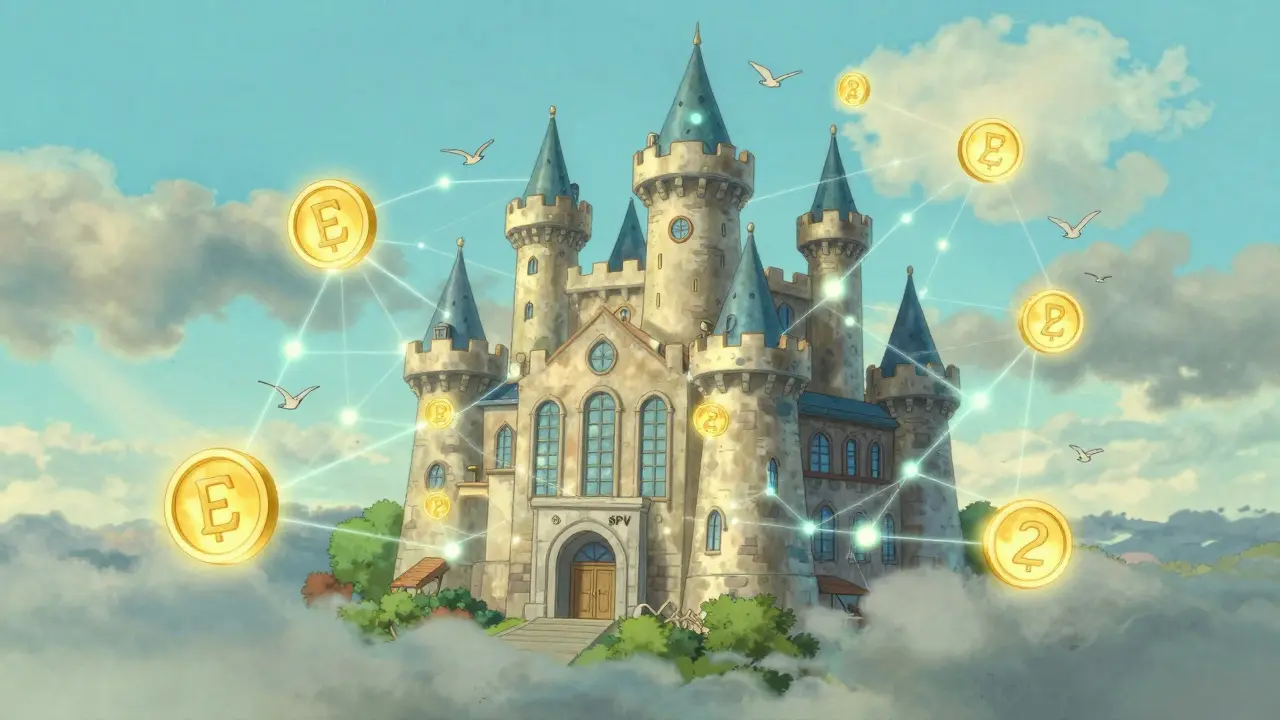
Real estate security tokens are blockchain-based digital assets that represent ownership in physical property. They\'re not just digital copies of deeds-they\'re actual securities regulated by financial authorities. This means they must follow strict rules, unlike regular cryptocurrencies. For example, when a company tokenizes a building, it creates a legal entity (like an SPV) that owns the property. Investors then buy tokens that give them rights to income or profits from that building. This process turns a single property into many small, tradable pieces.
How Real Estate Security Tokens Work
Here\'s how it actually works in practice. A Special Purpose Vehicle (SPV) a legal entity created to hold the real estate asset is formed. This SPV legally owns the property, while tokens represent ownership shares. These tokens usually follow the ERC20 a standard for creating tokens on Ethereum protocol on blockchain networks like Ethereum. smart contracts self-executing code on a blockchain that automates transactions handle everything from dividend payments to ownership transfers without intermediaries. Investors can hold tokens in their own wallets or use custodians for safekeeping. The key is that the token itself is just a digital proof of ownership, while the SPV handles the legal and physical aspects.
Regulatory Framework: Why They\'re Treated as Securities
Regulators don\'t care if it\'s on a blockchain or paper-they care about the substance. The Howey Test a legal framework used by the SEC to determine if an asset is a security is the main tool. If a token promises profit from others\' efforts, it\'s a security. For real estate tokens, this means they must comply with SEC rules. Options include Regulation D a SEC exemption allowing private offerings to accredited investors or Regulation A+ a SEC exemption allowing public offerings with limits. The Securities and Exchange Commission (SEC) the U.S. government agency overseeing securities markets has fined companies like Blockstream $30 million for unregistered token sales. Compliance isn\'t optional-it\'s the foundation of these tokens.
| Feature | Security Tokens | Utility Tokens |
|---|---|---|
| Purpose | Investment vehicle representing ownership or debt | Access to a product or service |
| Regulation | Regulated as securities by agencies like the SEC | Generally not regulated as securities |
| Use Case | Real estate, stocks, bonds digitized | Gaming, platform access, tokens for services |
| Example | Tokenized Manhattan apartment building | Token for a decentralized storage service |
Benefits of Tokenized Real Estate
Tokenization solves real problems in real estate. Traditional investing requires $10,000+ minimums for even small properties. Tokens bring that down to $100 or less. This opens up opportunities for everyday investors. Liquidity is another huge benefit. Selling a physical building can take months or years. Tokenized shares can trade 24/7 on specialized platforms. Transparency improves too-all transactions are on the blockchain. Plus, smart contracts automatically handle payments, reducing errors and costs. For example, a $50 million commercial property tokenized by JPMorgan in September 2023 settled in minutes instead of weeks.
Challenges and Risks
It\'s not all smooth sailing. The biggest hurdle is regulation. Each U.S. state has its own rules, plus federal laws. This complexity has delayed 63% of planned tokenization projects. Trading is another issue. Security tokens can\'t trade on regular stock exchanges-they need specialized Alternative Trading Systems (ATS) regulated platforms for trading securities. These are limited and often require accredited investors. There\'s also market uncertainty. A SEC proposal for a "Digital Asset Securities Framework" in Q1 2024 might clarify things, but until then, it\'s a gray area. Plus, if the underlying property is damaged or the SPV fails, token holders could lose everything.

Real-World Examples in 2026
Several companies are making it happen. INX raised $22 million in Q2 2023 for a tokenized Manhattan apartment building. Blocksquare got SEC approval for its Regulation A+ offering in April 2023, selling European commercial properties. JPMorgan completed its first tokenized real estate transaction in September 2023-a $50 million Texas property settled via JPM Coin. These examples show how tokenization works in practice. They also prove that with proper compliance, the technology delivers real results: faster deals, lower costs, and broader access.
What\'s Next for Real Estate Security Tokens?
Experts predict big growth. EY forecasts 10% of commercial real estate transactions will involve tokenized components by 2027. The global market could hit $16.3 trillion by 2030. But adoption will depend on clearer regulations. The SEC\'s upcoming framework will be crucial. Meanwhile, platforms like RealT (residential focus) and DigiShares (compliance infrastructure) are building the tools needed for wider use. Residential properties remain tricky due to complex local laws, but commercial real estate is leading the way. As technology matures and regulations stabilize, tokenized real estate could become as common as online banking.
Are real estate security tokens legal?
Yes, they\'re legal when compliant with securities regulations. The SEC treats them as securities, so issuers must follow rules like Regulation D or Regulation A+. Non-compliant offerings can face penalties, like Blockstream\'s $30 million fine in 2022. Properly structured tokens are fully compliant financial instruments.
How do I buy real estate security tokens?
You need to use a regulated platform that handles security token offerings. Platforms like INX, DigiShares, or RealT offer tokenized properties. Most require you to be an accredited investor or meet specific criteria under SEC rules. Always verify the platform\'s compliance status before investing-unregulated offerings can be illegal and risky.
What\'s the difference between security tokens and Bitcoin?
Bitcoin is a cryptocurrency designed for peer-to-peer transactions without regulation. Security tokens represent ownership in real-world assets like property or stocks and are strictly regulated by financial authorities like the SEC. Security tokens are investment vehicles, while Bitcoin is a speculative asset with no underlying asset backing it. This regulatory difference is why security tokens can\'t be traded on regular crypto exchanges.
Can I invest in residential properties with tokenized tokens?
Yes, but it\'s more complex than commercial properties. Platforms like RealT specialize in residential tokenization, but each U.S. state has different rules for real estate. Some states require specific licensing or have stricter investor requirements. Currently, most residential tokenization projects are small-scale and limited to certain regions. Always check local regulations before investing.
What happens if the underlying property is sold?
When the property is sold, the proceeds are distributed to token holders based on their ownership percentage. Smart contracts automate this process, ensuring transparency and speed. For example, if a tokenized building sells for $10 million, each token holder gets their share immediately. This is faster and more efficient than traditional real estate sales, which can take months to settle.




Paul Gariepy
February 6, 2026 AT 13:32Real estate tokenization is a game-changer!! It's amazing how blockchain allows small investors to participate in high-value properties. I mean, who wouldn't want to own a piece of a skyscraper for just $100? This democratizes real estate investment, and it's exciting to see the potential. However, I'm concerned about regulatroy compliance; not all platforms are following SEC rules properly. But overall, this is a huge step forward for accessible investing. Let's keep pushing for transparency and security in this space!!
Brendan Conway
February 7, 2026 AT 16:20Interesting points. Tokenization does make real estate more accessible. But i wonder if the regulatory hurdles will slow things down. It's a complex system, but maybe it's worth it. Just need to make sure it's done right. Not sure how the market will react long-term, but it's a cool idea.
Katie Haywood
February 8, 2026 AT 21:00Wow, $100 for a skyscraper piece? Sounds too good to be true. I mean, sure, it's possible, but let's not forget the SEC is watching like a hawk. If you're not compliant, you're gonna get fined like Blockstream did. But hey, maybe it's the future. Just don't go throwing all your money into it without checking the details. Trust me, I've seen too many 'revolutionary' investments crash and burn.
Oliver James Scarth
February 9, 2026 AT 05:15Your skepticism is understandable, but I must emphasize that the regulatory framework is robust and designed to protect investors.
The SEC's involvement ensures that only legitimate projects proceed.
In fact, the United Kingdom has its own stringent regulations for such instruments, which are often more rigorous than those in the US.
Therefore, I believe that with proper oversight, these tokens can indeed revolutionize the industry without compromising safety.
However, it's important to recognize that regulatory compliance varies by jurisdiction.
In Europe, for instance, MiCA provides a comprehensive framework that mandates strict disclosure requirements.
Meanwhile, in the US, the Howey Test is applied to determine if a token qualifies as a security.
This means that issuers must navigate a complex web of legal requirements.
Additionally, state-level regulations can impose further constraints.
For example, California's Department of Financial Protection and Innovation has specific rules for digital assets.
It's also worth noting that the SEC has been proactive in enforcing compliance, as seen in the Blockstream case.
The $30 million fine underscores the seriousness of regulatory adherence.
Furthermore, the development of Alternative Trading Systems (ATS) is critical for lawful trading of security tokens.
These platforms are specifically designed to handle securities transactions, ensuring that all trades comply with relevant laws.
Without such infrastructure, the market would face significant risks.
In conclusion, while challenges exist, the regulatory environment is evolving to support secure and compliant tokenization. This bodes well for the future of real estate investment through blockchain technology.
Freddie Palmer
February 10, 2026 AT 02:56Ah, yes! The SEC's role is crucial; however, state-level regulations interact with federal ones in complex ways. For instance, California has unique rules that complicate things. The UK's approach is fascinating, and it's interesting how different jurisdictions handle this.
Paul Jardetzky
February 11, 2026 AT 18:30Tokenized real estate is the future! 🚀 Imagine owning a slice of a luxury building with just $100. It's incredible how blockchain is breaking down barriers. This is a game-changer for everyday investors. Let's embrace this innovation and make real estate investing accessible for everyone! 💪
Matt Smith
February 13, 2026 AT 18:24Ugh, another 'game-changer' hype piece. Real estate tokenization is a scam waiting to happen. The SEC is barely keeping up, and most platforms are dodging regulations. Remember the $30M fine for Blockstream? Yeah, that's just the tip of the iceberg. Don't fall for this crypto-fueled nonsense. 🤡
Alex Garnett
February 14, 2026 AT 18:41Tokenization is merely a buzzword. The real issue is that these 'security tokens' are nothing more than thinly veiled speculation vehicles. Without proper oversight, they're a regulatory nightmare. The SEC is already overwhelmed. I doubt this 'revolution' will amount to anything substantial. It's all smoke and mirrors.
Ryan Chandler
February 16, 2026 AT 03:28Ah, the old 'smoke and mirrors' argument! But let's not dismiss innovation so quickly. Tokenization has the potential to reshape global real estate markets, enabling cross-border investments and unprecedented liquidity. It's not just about money-it's about democratizing access worldwide. The future is here, and it's dazzling!
Ajay Singh
February 17, 2026 AT 10:15Tokenization works.
aryan danial
February 18, 2026 AT 21:50The notion that tokenization is merely hype is shortsighted; the underlying technology has profound implications for global asset ownership. However, it's crucial to recognize that this innovation is not without its complexities. The integration of blockchain into traditional real estate markets requires meticulous attention to regulatory frameworks, which vary significantly across jurisdictions. For instance, the European Union's MiCA regulations present a different landscape compared to US SEC guidelines. This complexity necessitates a nuanced approach, yet many proponents oversimplify the challenges. It's not just about technology-it's about systemic change requiring collaboration among legal experts, technologists, and financial institutions.
Kieren Hagan
February 19, 2026 AT 02:41Your optimism is well-founded. However, it's important to note that regulatory compliance remains a critical factor. While the potential is immense, success depends on adhering to SEC guidelines and ensuring proper structuring. A balanced approach that combines innovation with strict adherence to legal requirements is essential for sustainable growth in this space.