
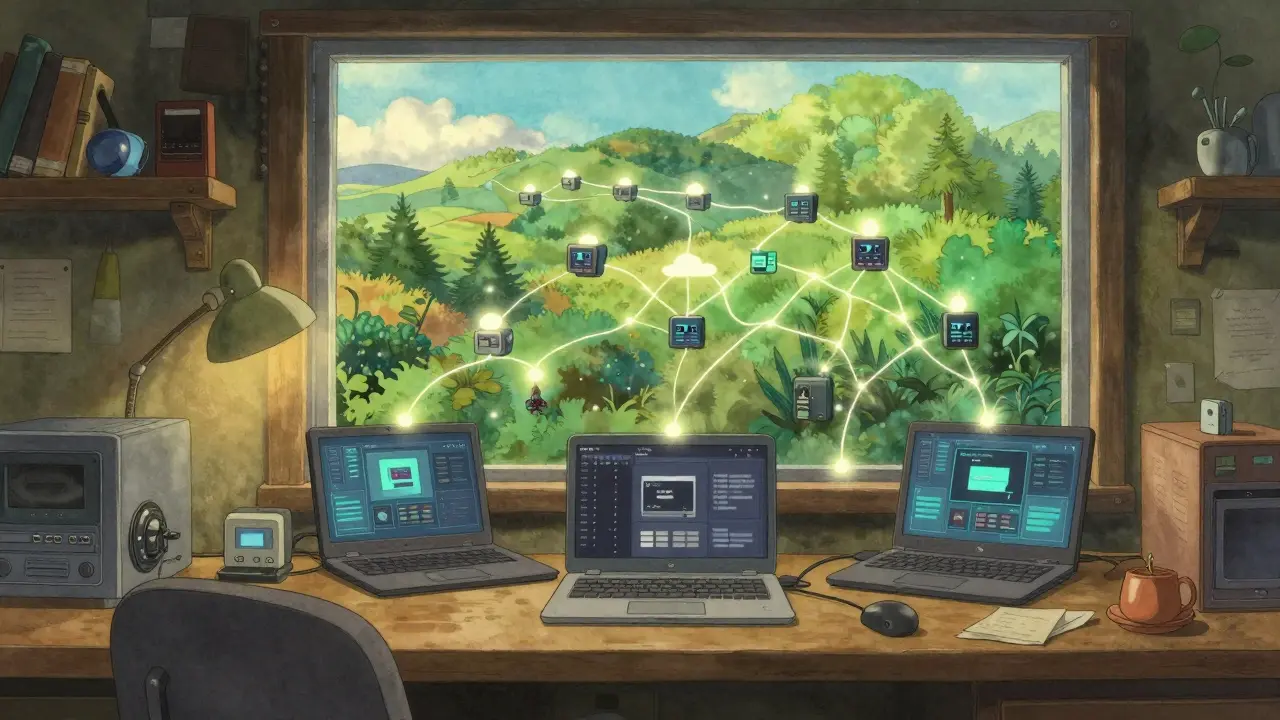
Most of us have grown used to paying monthly subscriptions for cloud storage, trusting a few giant companies to keep our photos and documents safe. But what happens when those companies change their terms, hike prices, or suffer a massive breach? Autonomi is a post-quantum, peer-to-peer decentralized data storage and retrieval network that removes the middleman entirely. Instead of a central server, it turns everyday devices-like your old laptop or a Raspberry Pi-into a global, permanent hard drive that no single entity can shut down or control.
The Core Idea Behind Autonomi
Unlike a typical blockchain that focuses on recording transactions, Autonomi is designed for the heavy lifting of data. It uses a distributed hash table to scatter encrypted chunks of data across a vast network of participants. This means there are no user accounts to hack and no central authority to request a password reset from. You simply upload your data, and the network ensures it stays there permanently.
One of the biggest headaches with decentralized storage is the "rental" model, where you pay every month to keep your files alive. Autonomi flips this script. You pay a one-time upload fee, and your data is stored permanently. This creates a truly autonomous system where your digital assets don't depend on a recurring credit card charge to exist.
Solving the Quantum Threat
If you've followed crypto news, you've probably heard that quantum computers could one day crack the encryption we use today. Most networks are still using "classical" cryptography, which is like using a lock that a super-strong future computer could simply snap. Autonomi is built specifically to survive this future.
The network implements Post-Quantum Cryptography, using specific standards like ML-DSA-65 for digital signatures and ML-KEM-768 for key exchanges. By adopting these FIPS-approved standards, Autonomi ensures that your data remains secure even if quantum computing becomes mainstream. It doesn't just provide a "patch' for the future; it's built from the ground up without any classical fallback options, meaning it doesn't leave any old, weak doors open for attackers.
How the ANT Token Works
To keep this massive machine running without a CEO or a corporate office, the network uses the ANT token. Think of Autonomi ANT as the fuel or the "oil" that keeps the network's economy moving. It handles three main jobs: payment, reward, and service access.
- Payment: When you want to store data permanently, you pay the network in ANT.
- Rewards: People who provide their spare hard drive space and bandwidth (node operators) earn ANT as a reward for their contribution.
- Agent Economy: As AI agents become more common, ANT allows these autonomous bots to pay each other for services like messaging or data retrieval without needing a human to sign a check.
| Attribute | Value |
|---|---|
| Maximum Supply | 1.2 Billion ANT |
| Circulating Supply | 460 Million ANT |
| Blockchain Platform | Arbitrum (Ethereum L2) |
| Primary Use Case | Utility and Storage Payment |

The Technical Engine: Zero-Knowledge and QUIC
Privacy in Autonomi isn't just a promise; it's baked into the math. The network uses a zero-knowledge architecture, meaning the people hosting your data have no idea what is actually inside the files. Your data is chunked and encrypted on your own device using a scheme that combines ChaCha20-Poly1305 and BLAKE3 hashing before it ever touches the internet. To the node operator, your file looks like random digital noise.
Connecting these devices is also a challenge, as most home routers block incoming connections. Autonomi solves this using QUIC NAT traversal. This technology allows devices to find and talk to each other directly, bypassing the need for central coordination servers. This ensures the network is truly peer-to-peer, making it incredibly difficult to censor or block.
Autonomi vs. Traditional Cloud Storage
When you compare Autonomi to a service like Google Drive or Dropbox, the difference is fundamental. Centralized providers offer convenience but take away your sovereignty; they can scan your files for "policy violations" or lock you out of your account. Autonomi offers a Trusted Data Layer where you hold the keys and the network just provides the space.
Even compared to other decentralized options, Autonomi's claim of accessing over 40 Zettabytes of untapped storage across the globe is ambitious. By leveraging the "waste" of empty space on millions of home PCs, it creates a resource pool that dwarfs traditional data centers.

Getting Started with ANT
If you're looking to get involved, you'll need a wallet that supports the Arbitrum One network. Since ANT operates on this Layer 2 solution, transactions are much cheaper and faster than they would be on the main Ethereum chain. You can acquire tokens through decentralized platforms like Uniswap V3 or centralized exchanges such as BitMart and Ourbit.
For those who want to earn rather than just buy, running a node is the primary way to generate ANT. By dedicating a portion of your hardware's storage and bandwidth to the network, you receive payments directly to your Ethereum wallet. It's a way of turning your hardware into a passive income stream while supporting a more open internet.
The Future of Data Sovereignty and AI
We are entering an era where AI and robotics will handle more of our daily tasks. The risk is that our personal knowledge and thoughts become property of the AI companies training their models. Autonomi positions itself as a shield against this. By giving individuals a place to store their data that is immune to corporate control, it ensures that as AI grows, humans keep their autonomy.
A self-governing system that doesn't require a central authority is the only way to ensure data lasts for decades without the risk of a company going bankrupt or changing its mind about who is allowed to access the web.
Is Autonomi the same as a blockchain?
Not exactly. While it uses tokens and decentralized principles, it functions more as a peer-to-peer data network than a traditional ledger. It focuses on storing and retrieving large files efficiently using a distributed hash table rather than recording every single transaction on a chain.
What does "post-quantum" actually mean for my data?
It means the encryption used is designed to be secure against attacks from quantum computers. While current computers can't break most encryption, a powerful quantum computer could. Autonomi uses FIPS 203 and 204 standards to ensure your data is safe even in that future scenario.
Do I have to pay a monthly fee to use Autonomi?
No. One of the core features of the network is the one-time upload fee. Once you pay the initial cost in ANT tokens to store your data, it is stored permanently without recurring subscription fees.
How do I earn ANT tokens?
The most common way to earn ANT is by running a network node. By contributing your spare storage capacity and bandwidth to help other users store and retrieve data, the network rewards you with tokens paid directly to your wallet.
Which blockchain does the ANT token use?
The ANT token operates on Arbitrum, which is an Ethereum Layer 2 (L2) blockchain. This allows for faster speeds and lower gas fees than the main Ethereum network.






Caiaphas Konkol
April 27, 2026 AT 02:33The move toward post-quantum cryptography is a necessity, not a luxury. Most of the masses are blissfully ignorant of how their data is actually stored, blindly trusting corporate silos that are essentially honey pots for state-sponsored actors. A truly decentralized architecture is the only logical conclusion for those of us who actually understand the looming threat of Shor's algorithm.
Charlie Queen
April 29, 2026 AT 01:59This sounds like such a game changer for digital freedom! 🚀 Love seeing tech that empowers the individual and lets us take control of our own stuff again. Total vibes! ✨
Robert Mosolygo
April 30, 2026 AT 04:01It is incredibly naive to assume that a distributed hash table solves the inherent fragility of peer-to-peer systems. One must consider the Sybil attack vectors present in any network that rewards node operators with a utility token. The claim regarding 40 Zettabytes of untapped storage is a marketing fabrication designed to lure in retail investors. The actual available bandwidth on home connections is a bottleneck that will inevitably lead to massive latency issues. Furthermore, the reliance on Arbitrum merely shifts the centralization risk to a Layer 2 sequencer. We are essentially trading one set of overlords for another, albeit with more complex mathematics. The encryption standards mentioned are indeed robust, but the human element remains the weakest link. Most users will lose their private keys, and in a system with no central authority, that data is gone forever. This is not a solution; it is a sophisticated trap for the technologically overconfident.
Eric Raines
April 30, 2026 AT 05:40I've seen a million projects claim to 'disrupt' storage and they all end up as ghost towns because nobody actually wants to manage their own nodes.
Guy Bianco
May 2, 2026 AT 02:35It may be challenging for some to set up initially, but the learning curve is a worthwhile investment for the sake of privacy. :)
Tony Gurley-Ward
May 3, 2026 AT 20:55Paying a one-time fee for permanent storage is a delightfully chaotic way to spite the subscription industrial complex. Why rent your own memories when you can just scatter them across a thousand strangers' old laptops? It's poetic in a weird, digital sort of way.
Jennifer L
May 4, 2026 AT 11:14Oh my goodness, the idea of my photos being safe from those scary hackers is just wonderfull!! I realy hope this helps people who are scared of loseing their precious memories because it is just so heartbraking when things vanish into the void of the internet...
It is just so emotinal to think about!
Hannah Rubia
May 6, 2026 AT 01:31For those interested in the technical implementation, the use of ML-KEM-768 is a significant decision. It aligns with the NIST standards for post-quantum key encapsulation, which ensures a high level of security against quantum-enabled adversaries. I recommend that potential node operators verify their hardware specifications to ensure optimal uptime for the network.
Jagdish Sutar
May 7, 2026 AT 03:53It is great to see how such technology can be accessed globally, whether you are in India or the US. Truly an inclusive way to build the future of the web!
Sarah Fisher
May 7, 2026 AT 07:25The notion of data sovereignty is essentially a quest for digital existence. If we do not own the medium on which our thoughts are stored, we are merely tenants in someone else's reality, and Autonomi seems to offer a path toward actual ownership.
Doc Coyle
May 8, 2026 AT 22:26Common sense tells you that free storage is never really free. You're just paying with your electricity and hardware wear and tear.
Gary Lingrel
May 9, 2026 AT 23:17who cares about quantum computers lol just keep your stuff on a thumb drive 🙄
jill huyo-a
May 11, 2026 AT 02:30The part about AI agents paying each other is really interesting. I wonder how that would actually look in practice for daily tasks.
Matthew Morse
May 12, 2026 AT 20:03basically just another way to mine coins using a hard drive
Candace Sherrard
May 13, 2026 AT 21:20I find myself pondering the strange paradox of trust here, where we are asked to abandon the trust we place in a corporate entity with a known legal identity and instead place our trust in a mathematical consensus and the collective reliability of a thousand anonymous Raspberry Pis scattered across the globe, which is a fascinating shift in the sociology of data.
Paige Raulerson
May 15, 2026 AT 14:43A one-time fee is cute, but let's be real, the UX of decentralized storage is usually a nightmare and most people just want a button that works.
praveen subbiah
May 15, 2026 AT 20:19India has so many tech enthusiasts who would love to run these nodes! This is the kind of innovation that will make us a global leader in the new internet era!
Ali Tate
May 17, 2026 AT 00:45Zettabytes of waste space is a wild claim but hey if the math holds up it's a total slaughter of the cloud giants
debashish sahu
May 17, 2026 AT 20:56It is an interesting approach to data storage. I hope it provides a stable alternative for many users.
Lisa Camp
May 19, 2026 AT 07:41STOP TALKING AND JUST START RUNNING A NODE ALREADY! GET THAT ANT AND SECURE YOUR DATA NOW!