

Imagine your car talking to you, adjusting the temperature before you feel cold, and controlling your smart home lights while you drive-all without taking your hands off the wheel. That is the promise behind Dtec, a cryptocurrency project aiming to merge artificial intelligence with automotive data. But what exactly is the DTEC token, and why does it exist?
If you have seen the ticker DTEC on exchanges like Binance or MEXC, you might be wondering if this is just another meme coin or if there is actual utility behind it. The short answer is that DTEC is designed as an incentive mechanism for an ecosystem called Dtec AI Blockchain. It rewards drivers for sharing anonymized vehicle data to train AI models.
However, digging into the details reveals a lot of conflicting information about supply, price, and technology. This guide breaks down what Dtec actually is, how its token works, and what you need to know before considering it.
The Core Concept: AI Meets Automotive Data
To understand the DTEC token, you first need to understand the product it supports. Dtec is not just a currency; it is part of a broader platform focused on the Internet of Things (IoT) in vehicles. The project claims to build a "comprehensive digital ecosystem" that connects cars, smart devices, and drivers through a single interface.
The centerpiece of this ecosystem is the DtecA application. This software acts as a voice-controlled virtual assistant for your vehicle. Instead of fumbling with buttons while driving, users can issue voice commands to control in-car hardware and even external IoT devices, like turning on your home coffee maker or checking security cameras.
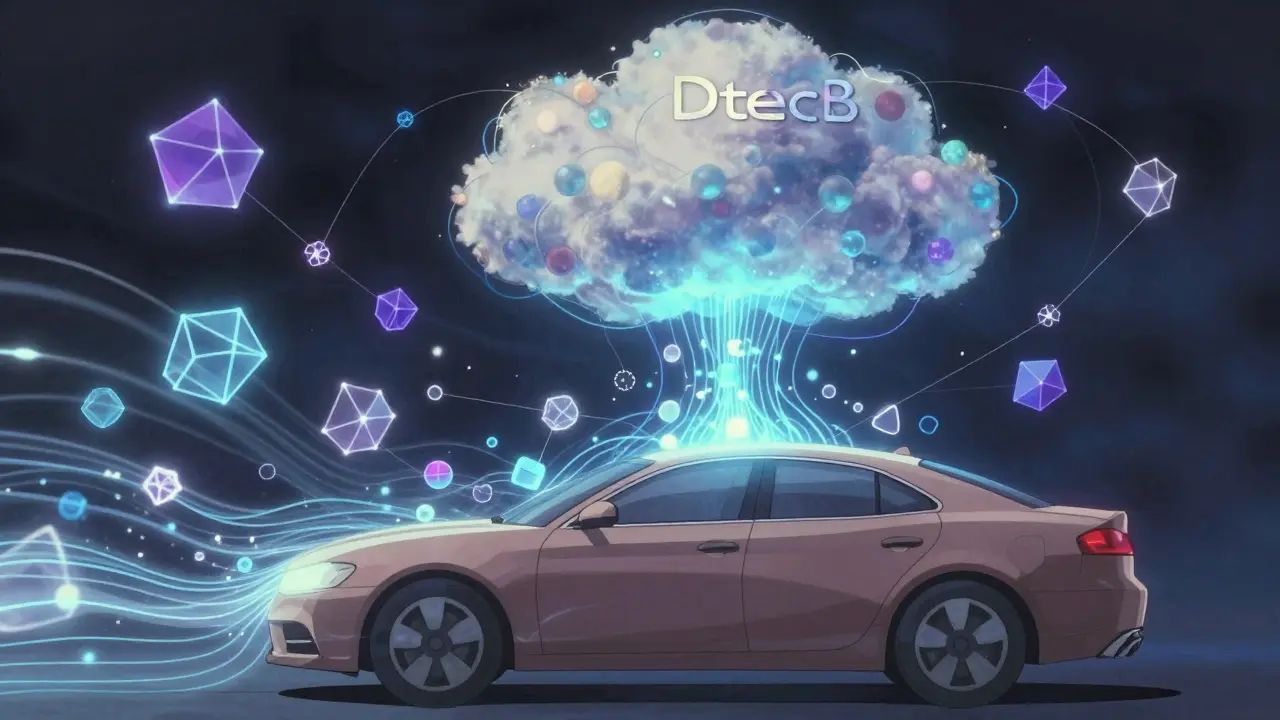
But here is the catch: AI needs data to learn. The more driving habits, sensor readings, and usage patterns the system collects, the smarter it becomes. This is where the blockchain comes in. Dtec uses the DTEC token to incentivize users to share this valuable data securely and anonymously.
How Does the DTEC Token Work?
In most crypto projects, tokens are used for governance or payments. In the Dtec ecosystem, the primary role of the DTEC token is transactional and incentive-based. Here is how the cycle works:
- Data Collection: You install the DtecA module on your vehicle’s operating system. It collects telemetry data-speed, braking patterns, location, and more.
- Anonymization: The data is stripped of personal identifiers using cryptographic methods to protect your privacy.
- Sharing: This clean data is sent to the Dtec network to help train their AI model, known as DtecB.
- Reward: In exchange for contributing this data, users receive DTEC tokens.
The project also mentions using smart contracts to automate these agreements. This ensures that when you share data, the reward is distributed transparently without a middleman holding your earnings. According to MEXC, the underlying blockchain uses a "unique consensus mechanism" and involves mining, though specific technical details like hash algorithms or block times remain vague in public documentation.
Tokenomics: A Messy Picture
If you are looking at DTEC from an investment perspective, the first thing you will notice is that the numbers don't add up across different platforms. This is a major red flag for due diligence. Let's look at the discrepancies regarding supply and market cap.
| Source | Total Supply Claimed | Circulating Supply | Market Cap Estimate |
|---|---|---|---|
| Official Site (dtec.space) | 338,415,648 | Not specified | N/A |
| CryptoRank | 900,000,000 | 6.03 Million | $361,800 |
| CoinGecko | N/A | 27 Million | ~$5.2 BTC equivalent |
| Binance | N/A | 122.54 Million | $1.31 Million |
| MEXC | N/A | 167.60 Million | $1.11 Million |
As you can see, the circulating supply ranges from 6 million to over 167 million depending on who you ask. The total supply is listed as roughly 338 million by the official team but 900 million by third-party trackers. This inconsistency makes it difficult to calculate the true Fully Diluted Valuation (FDV) or assess scarcity accurately.
Funding history adds another layer of complexity. CryptoRank reports that the project raised $3.36 million ($2M from private rounds, $1.36M from public sale) with a valuation of $12.47 million at one point. However, current market caps hover between $360k and $1.3M, suggesting significant volatility or dilution since those early funding stages.
Price Performance and Liquidity
Where can you buy DTEC, and what is it worth? As of May 2026, DTEC is traded on several centralized exchanges, including Binance, MEXC, Gate.io, and LBank.
Prices vary slightly by platform due to liquidity differences:
- Binance: ~$0.0107 per DTEC
- MEXC: ~$0.0066 per DTEC
- Crypto.com Index: ~$0.0062 per DTEC (not tradable directly on their platform)
Daily trading volumes typically range between $130,000 and $176,000. While this indicates active interest, it is relatively low compared to top-tier cryptocurrencies. For context, DTEC ranks around #1700-#1900 by market capitalization globally. This places it firmly in the "small-cap" category, which means high risk and high potential volatility.
Be aware that prices can swing wildly. One snapshot showed a 24-hour increase of 7.3%, while others showed near-zero movement. Always check real-time charts on multiple exchanges before making any decisions.
Security and Privacy Concerns
One of the biggest selling points of Dtec is privacy. The official site states that data is transferred using "advanced cryptography" without identification. This suggests they aim to separate your driving behavior from your personal identity. However, the project does not publish detailed technical audits or whitepapers specifying the encryption standards used (e.g., AES-256, Zero-Knowledge Proofs).
From a crypto-security standpoint, the lack of transparency is concerning. There are no public records of independent security audits for the DtecA software or the underlying blockchain infrastructure. Furthermore, the founding team remains largely anonymous. The only physical address provided is Keizersgracht 555, Amsterdam, Netherlands, but no corporate registration name is linked to it publicly.
When investing in projects where the team is unknown and the tech stack is vaguely described, you must assume higher risk. If the AI model fails to gain adoption by car manufacturers, the value proposition of the token collapses.
Is Dtec a Good Investment?
This depends entirely on your belief in the future of connected cars and AI data markets. If autonomous driving and smart vehicle ecosystems become mainstream, platforms that aggregate and monetize driving data could be valuable. Dtec positions itself early in this niche.
However, consider the following risks:
- Adoption Barrier: Getting OEMs (car manufacturers) to allow third-party apps like DtecA to access vehicle systems is incredibly difficult. Tesla, Ford, and GM have their own closed ecosystems.
- Token Utility: Currently, the main use case is rewarding data sharing. If users stop sharing data because the rewards aren't attractive enough, the network effect stalls.
- Data Discrepancies: The inconsistent supply numbers suggest poor communication or potential manipulation in reporting metrics.
For developers, Dtec offers a glimpse into how blockchain can handle IoT data integrity. For traders, it is a speculative small-cap play with limited liquidity depth.
How to Get Started with DTEC
If you decide to explore DTEC, here is the practical path:
- Choose an Exchange: Gate.io currently shows the highest volume for DTEC/USDT pairs. Binance and MEXC are also viable options.
- Create a Wallet: Since the exact blockchain standard (ERC-20, BEP-20, etc.) isn't clearly unified across sources, verify the contract address on the exchange before withdrawing. Using a non-custodial wallet like MetaMask or Trust Wallet is recommended for security.
- Buy USDT First: Most DTEC pairs are against Tether (USDT). Buy USDT, then swap for DTEC.
- Monitor Official Channels: Follow updates from dtec.space for any changes to the DtecA app availability or new partnerships.
Remember, never invest more than you can afford to lose, especially in tokens with unclear fundamentals and anonymous teams.
What is the main purpose of the DTEC token?
The DTEC token is primarily used as an incentive for users who share their vehicle and driving data with the Dtec ecosystem. By installing the DtecA app, drivers contribute data that trains the DtecB AI model, and they are rewarded with DTEC tokens for this contribution.
Which exchanges list the DTEC coin?
DTEC is traded on several centralized exchanges including Binance, MEXC, Gate.io, and LBank. Crypto.com tracks its price but does not currently offer direct trading for the token on its platform.
Who created the Dtec project?
The founding team behind Dtec is largely anonymous. Public sources do not disclose the full names of the founders or the specific legal entity behind the project. The only known contact address is located in Amsterdam, Netherlands.
Why are the DTEC supply numbers so different?
There is significant inconsistency in reported data. The official site lists a total supply of ~338 million, while CryptoRank lists 900 million. Circulating supply figures vary from 6 million to 167 million across different tracking platforms. This suggests differing methodologies or outdated snapshots among data providers.
Is Dtec safe to use for storing data?
Dtec claims to use advanced cryptography to anonymize user data before transferring it to the network. However, the project has not published independent security audits or detailed technical specifications regarding its encryption protocols, which poses a potential risk for privacy-conscious users.
What is DtecA?
DtecA is the front-end application of the Dtec ecosystem. It serves as a voice-controlled virtual assistant for vehicles, allowing drivers to control in-car hardware and external IoT devices via voice commands while collecting data for the AI model.
Does Dtec have a mobile app?
Yes, the DtecA application is designed to be installed on vehicle operating systems and potentially smart platforms. It enables communication between the driver, the vehicle, and other IoT devices.
How much money did Dtec raise?
According to CryptoRank, the Dtec AI Blockchain project raised a total of $3.36 million, comprising $2.00 million from private funding rounds and $1.36 million from a public sale.





Barclay Chantel
May 30, 2026 AT 03:22Another anonymous team, vague tech specs, and conflicting supply numbers? This screams 'rug pull waiting to happen'. The fact that they can't even agree on whether there are 6 million or 167 million tokens in circulation is laughable. It’s not innovation; it’s negligence disguised as blockchain disruption. Stay away.
Craig Swanson
May 30, 2026 AT 10:08You’re missing the point entirely, Barclay. While I agree the data discrepancies are annoying, dismissing the whole concept because of poor documentation is lazy. Look at the potential for IoT integration in cars. If they fix the transparency issues, this could actually work. We need to push them toward better standards, not just trash the idea because it’s messy right now. Constructive criticism helps more than cynicism.
Bill Gunn
May 31, 2026 AT 11:38I’ve been looking into the DtecA app myself 🚗💨 and honestly, the voice control features sound slick if they actually deliver. But here’s the thing: why do we need a crypto token for this? Why not just use standard API access with privacy guarantees? The incentive model feels forced. Unless the AI training really needs decentralized data pooling, this tokenomics layer adds unnecessary complexity. 🤔
kamal ifrani
June 2, 2026 AT 00:29It is absolutely disgusting how these projects prey on people who don’t understand basic economics. They promise you’ll get rich by sharing your driving data, but look at the market cap! It’s tiny. And the team is anonymous? In Amsterdam? Please. This isn’t tech, it’s a scam wrapped in buzzwords. You people are blind to the obvious red flags because you want to believe in magic internet money. Shameful.
saradee dee
June 2, 2026 AT 13:10Oh my goodness, Kamal, you are so harsh! 😱 I know the risks are high, but imagine if it works! My car talking to my home lights sounds like something out of a sci-fi movie. I’m scared too, sure, but maybe we should give them a chance to prove themselves? It’s exciting, isn’t it? Or am I just naive? 🥺
Crystal Davis
June 3, 2026 AT 03:09Saradee, please do yourself a favor and read the whitepaper if one even exists. The lack of audits is not a 'risk', it’s a guarantee of failure. Anonymous teams + no security audits = zero trust. You’re playing Russian roulette with your savings. Don’t let excitement cloud your judgment. It’s not exciting; it’s dangerous.
Dana Rapoport
June 4, 2026 AT 03:01I think we’re all focusing too much on the price action and not enough on the philosophy of data ownership. The question isn’t just ‘will this coin go up?’ but ‘who owns our digital footprint?’ Even if Dtec fails, the conversation about incentivizing data privacy is vital. We need to rethink how value flows from users to corporations. This project might be flawed, but the underlying problem is real.
Hadleigh Edwards
June 5, 2026 AT 05:20That’s a very thoughtful perspective, Dana, and I appreciate you bringing that up because often we get so caught up in the technicalities of blockchain consensus mechanisms and token distribution models that we forget to ask the bigger questions about what it means for us as individuals to have our movements tracked and monetized, which is a fascinating topic that deserves more attention than just looking at charts, although I will admit that the charts are pretty scary right now with such low liquidity and high volatility, so while I agree with the philosophical point, I personally wouldn’t put any real money into this until I see some major automotive partnerships announced, because without adoption, the philosophy doesn’t pay the bills, and that’s just the reality of the crypto space we live in today.
stalin brian
June 6, 2026 AT 14:15hey guys i noticed the supply diffrences r crazy big. like 900m vs 338m? thats wild. also the price on binance is higher than mexc. arbitrage opportunity? or just bad liquidity? im curious if anyone tried buying on mexc and selling on binance. seems risky tho with the fees.
mark valmart
June 7, 2026 AT 00:06Yeah, Brian, I saw that too. The spread is huge. But honestly, with only $130k daily volume, you’d probably lose more in slippage and gas fees than you’d make. Plus, if the order books are thin, pulling out a decent amount could crash the price locally. I’d stick to watching it rather than trading it right now. Too choppy.
Christina Pearce
June 7, 2026 AT 19:19I’m keeping an eye on this, but I’m setting strict boundaries. No more than 1% of my portfolio, and only if they release a proper audit. I love the idea of rewarding users for data, but I won’t ignore due diligence. Has anyone found the actual contract address on Etherscan or BscScan? I want to verify the decimals and total supply myself before considering anything further.