

What exactly is NovaBank (NVB)? It’s not just another altcoin. NovaBank is a NVB crypto protocol built on DeFi 3.0 principles - a bold attempt to reinvent how decentralized finance works by removing banks, replacing them with smart contracts, and promising users steady returns without stablecoins. But here’s the catch: it’s also one of the most volatile tokens in recent memory, having crashed over 90% from its peak. If you’re wondering whether NVB is worth your attention, you need to understand how it actually works - not just the hype.
How NovaBank (NVB) Works: More Than Just Staking
NovaBank isn’t a coin you buy and hold like Bitcoin. It’s a full financial system built on blockchain. At its core is the NVB token, which isn’t pegged to the dollar like USDT or USDC. Instead, it’s backed by something called Risk-Free Value (RFV) - a theoretical floor of $1 USDT per NVB token. That means, in theory, the protocol should never let NVB trade below $1. But in practice? It’s been as low as $4.48 and as high as $82.18. So what’s holding it up?
The answer lies in three smart contracts that run the whole system:
- Bond Contract: Lets you buy NVB tokens at a discount by locking up other assets like USDT or ETH. The protocol uses your money to build its treasury, and in return, you get NVB cheaper than the market price. It’s like getting a bulk discount on crypto - but only if you’re willing to wait.
- Staking Contract: This is where most users earn rewards. You lock your NVB tokens in the staking pool, and the protocol pays you more NVB over time. Rewards compound automatically, meaning you earn interest on your interest. The protocol claims annual yields can hit up to 79x - but that’s under perfect conditions. Real-world returns are far lower and depend heavily on how many people are staking and bonding.
- Yield Vesting Contract: Your rewards don’t show up all at once. They’re released slowly over days or weeks. This is meant to stop people from dumping their coins immediately after earning them, which would crash the price. If you’re impatient, you can burn AVC tokens to speed up the release - more on that later.
These aren’t just features. They’re the engine. Without all three working together, the whole system falls apart.
The Dual-Token System: NVB and AVC
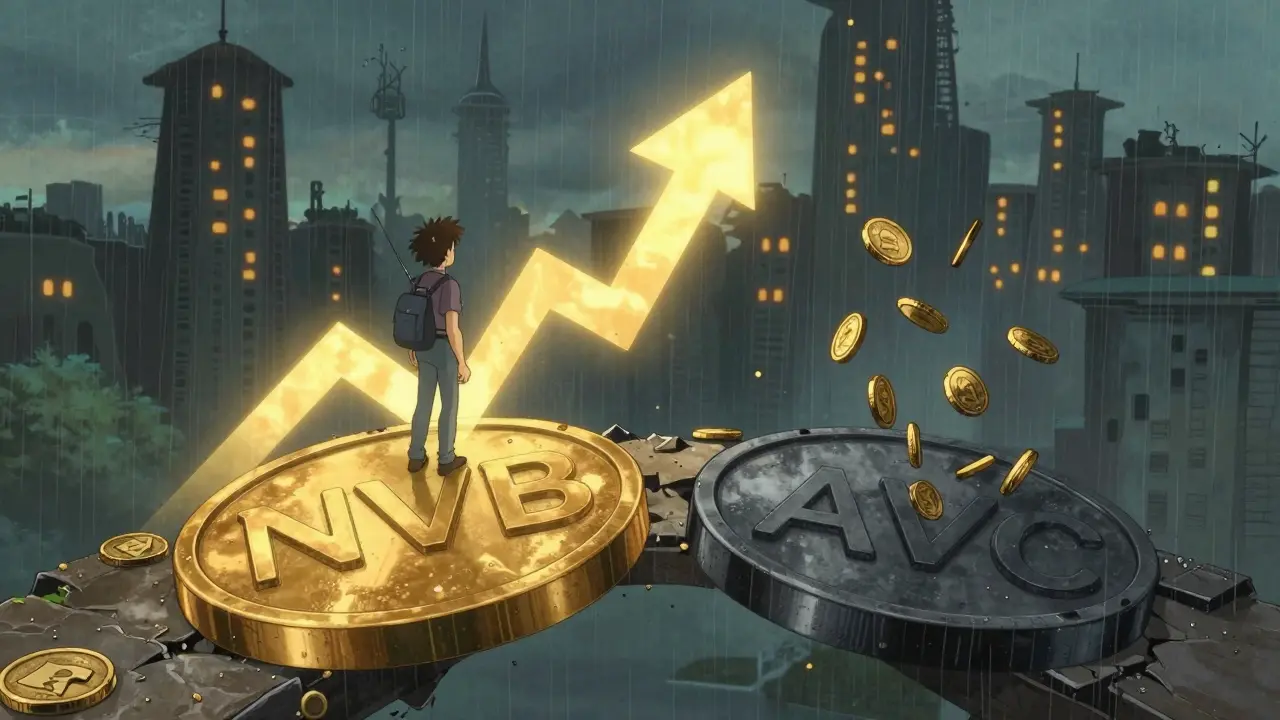
NovaBank doesn’t run on NVB alone. It uses a second token called AVC (Alterverse), which is led by Binance. This is unusual. Most DeFi projects use one token. NovaBank uses two - and they’re designed to feed each other.
Here’s how it works:
- You earn NVB by staking.
- You earn AVC by participating in community activities or buying it on exchanges.
- You can burn AVC tokens to unlock your staking rewards faster.
- Part of the revenue from burning AVC goes into a DAO treasury, which votes on whether to buy back and burn NVB tokens - reducing supply and potentially pushing the price up.
This creates a loop: more burning → more NVB buybacks → higher demand for NVB → higher price → more staking → more bonding → more revenue. It’s elegant on paper. But loops like this only work if people keep participating. And right now, participation is dropping.
Price, Supply, and Market Reality
As of February 2026, NVB is trading around $5.50 on CoinMarketCap. That’s down 93% from its all-time high of $82.18 in April 2025. On Binance, it’s listed at $9.26 - a big difference. Why? Because different exchanges have different liquidity and trading volume. Crypto prices aren’t uniform. They’re messy.
Here’s what the numbers say:
| Metric | Value | Source |
|---|---|---|
| Current Price | $5.49 | CoinMarketCap |
| Current Price | $9.26 | Binance |
| All-Time High | $82.18 | April 16, 2025 |
| All-Time Low | $4.48 | January 6, 2026 |
| Market Cap | $5.51 million | CoinMarketCap |
| Full Diluted Valuation | $9.14 million | Binance |
| Circulating Supply | 986,750 NVB | CoinMarketCap |
| Total Holders | 869,430 | Protocol Data |
That’s over 869,000 wallet addresses holding NVB. That’s not a small number. But look at the price drop. When a token loses 93% of its value, something changed. Was it the tech? No. The smart contracts still work. Was it the team? They haven’t vanished. It was trust. People realized the promises didn’t match the reality.
DeFi 3.0 or Just DeFi 2.0 with a New Name?
NovaBank calls itself DeFi 3.0 - the next evolution after DeFi 1.0 (basic staking) and DeFi 2.0 (bonding and liquidity mining). But what makes it 3.0? It’s mostly marketing. The core idea - staking and bonding - was proven by Olympus DAO in 2021. NovaBank added a second token, vesting schedules, and a few tweaks. That’s innovation? Maybe. But it’s not revolutionary.
Real DeFi 3.0 would mean integrating real-world assets - like bonds, real estate, or commodities - directly into the blockchain. NovaBank says it’s doing that, but there’s no public proof. No audits. No documentation. No asset backing. It’s all theoretical. And in crypto, theory doesn’t pay bills.
The Hidden Risk: Centralized Control
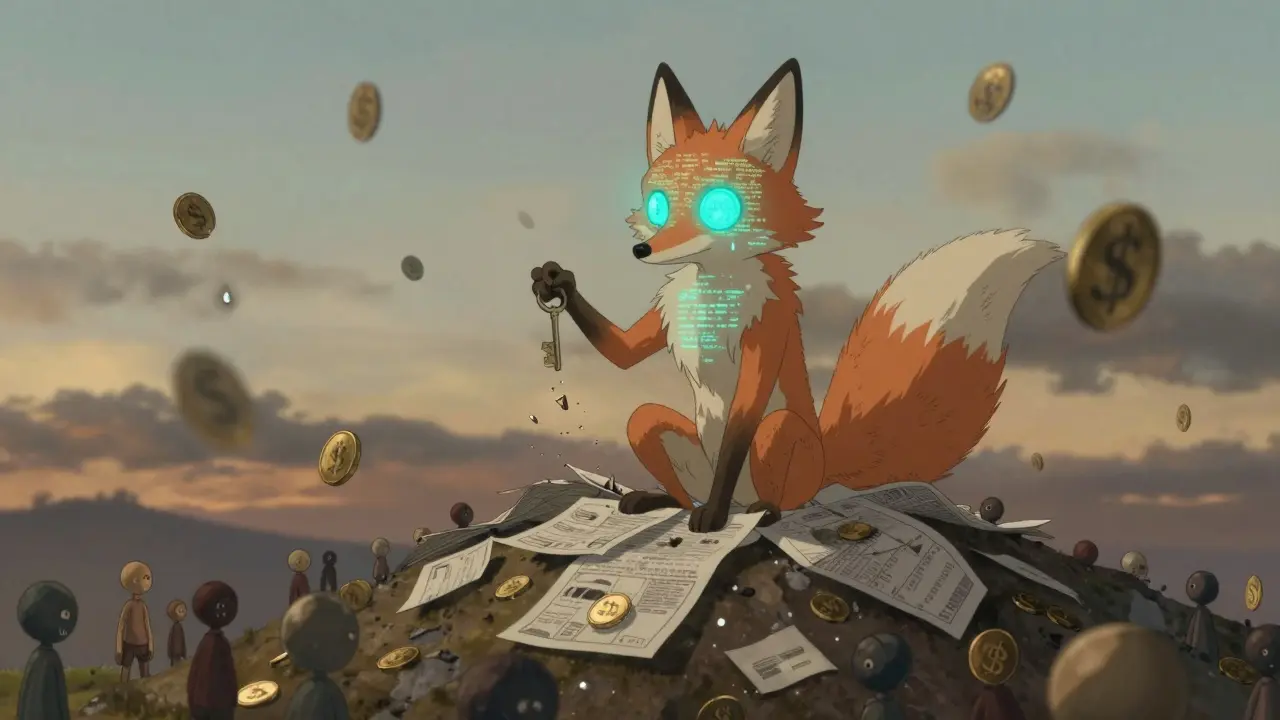
This is the part most people skip. NovaBank’s smart contracts can be changed - even stopped - by the owner. According to Gopluslabs, the contract owner can:
- Disable selling
- Change fees
- Mint new tokens
- Transfer tokens
That’s not decentralized. That’s a centralized system with a blockchain skin. You think you’re in control? You’re not. The team holds all the keys. If they decide to dump their tokens, or freeze withdrawals, or flood the market with new NVB - there’s nothing you can do. That’s not a protocol. That’s a company pretending to be a blockchain.
And yet, thousands still stake. Why? Because they believe the price will go back up. Or because they don’t know any better. Either way, you’re taking on risk you can’t see on a price chart.
Should You Invest in NVB?
If you’re asking this question, you’re probably already holding some NVB - or thinking about buying. Here’s the truth:
- Don’t invest money you can’t afford to lose. NVB has lost 93% of its value. It could go lower.
- Don’t assume staking rewards will save you. High APYs are tempting, but if the token crashes 50% while you’re staking, your gains vanish.
- Don’t trust the “RFV” of $1. It’s a target, not a guarantee. The market decides the price.
- Do your own research. Check the contract on Etherscan. Look at who controls it. Read the whitepaper - if it still exists.
NovaBank isn’t a scam. It’s a high-risk experiment. It has real code, real users, and real mechanics. But it’s also a gamble. The market has already voted: NVB is worth far less than it once was. Whether it recovers, collapses, or fades into obscurity - only time will tell.





Ruby Ababio-Fernandez
February 16, 2026 AT 13:20Alex Williams
February 18, 2026 AT 05:06Andrew Edmark
February 18, 2026 AT 14:16Ian Plunkett
February 19, 2026 AT 17:37Charrie VanVleet
February 21, 2026 AT 09:37Scott McCrossan
February 23, 2026 AT 06:03Beth Erickson
February 24, 2026 AT 15:45Jeremy Fisher
February 26, 2026 AT 08:54Sasha Wynnters
February 27, 2026 AT 09:40Rajib Hossaim
February 28, 2026 AT 06:37Jenn Estes
February 28, 2026 AT 18:08Anandaraj Br
March 2, 2026 AT 11:56AJITH AERO
March 3, 2026 AT 07:53Angela Henderson
March 4, 2026 AT 00:02Geet Kulkarni
March 5, 2026 AT 08:36Lauren Brookes
March 5, 2026 AT 16:30Chris Thomas
March 7, 2026 AT 03:06James Breithaupt
March 9, 2026 AT 01:41Sarah Shergold
March 9, 2026 AT 22:50Dominica Anderson
March 11, 2026 AT 18:38