
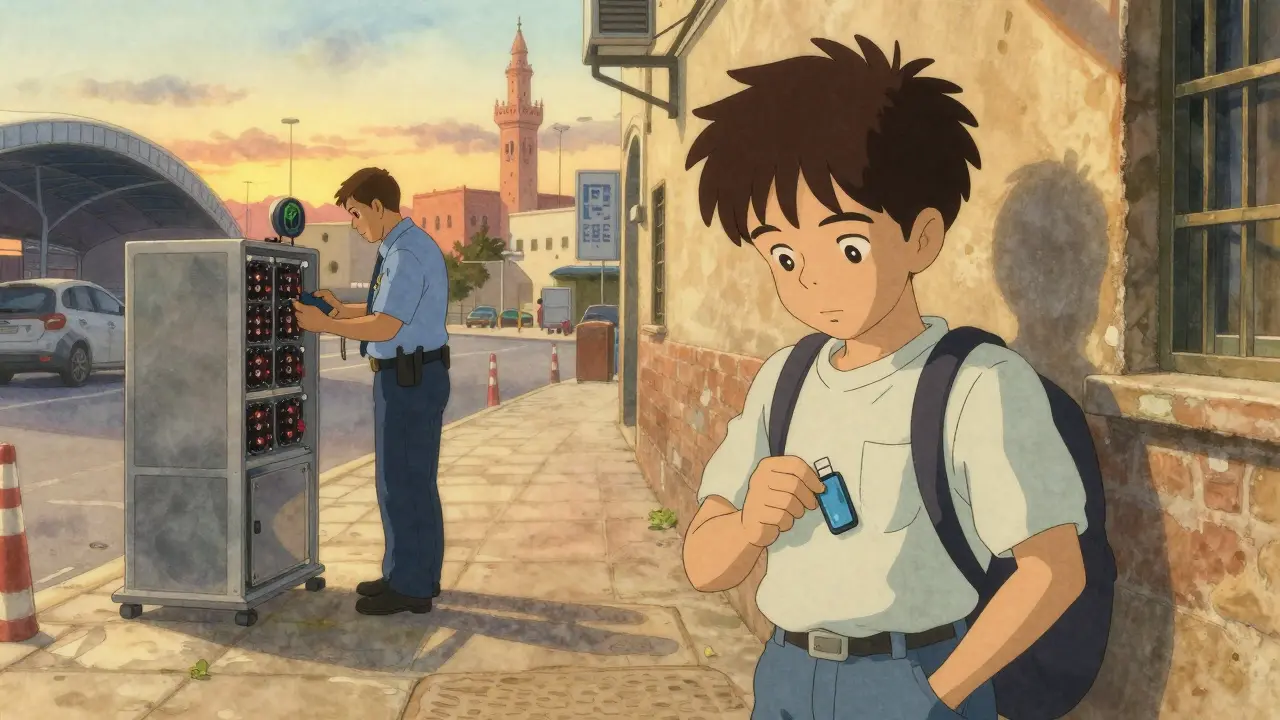
Tunisia doesn’t just restrict cryptocurrency - it bans it outright. Since May 2018, the Central Bank of Tunisia (BCT) has made it illegal to buy, sell, trade, mine, or even hold Bitcoin and other digital assets within the country. Unlike many nations that regulate crypto with licensing or taxation, Tunisia treats it like contraband. If you’re caught exchanging crypto, you could face up to five years in prison. This isn’t a warning - it’s enforced.
What’s Actually Illegal Under Tunisia’s Crypto Rules?
The ban covers every single activity involving cryptocurrency. Merchants can’t accept Bitcoin for goods. Exchanges can’t operate. Mining rigs can’t be imported - customs seizes them at the border. Even holding crypto in a wallet is technically a violation under currency control laws. Banks are ordered to block any transaction linked to crypto exchanges, and ATMs that once allowed Bitcoin purchases were shut down within months of the ban. The law doesn’t just target individuals. Companies that market tokens, run crypto platforms, or even advertise crypto services face heavy fines and criminal charges. In 2021, a 17-year-old Tunisian student was jailed for exchanging $150 worth of Bitcoin through a peer-to-peer chat group. The case sparked national debate, but no legal changes followed. Enforcement remains strict, with no tolerance for small-scale use.Why Did Tunisia Ban Crypto So Hard?
The ban wasn’t random. It came after years of unregulated Bitcoin trading through WhatsApp and Telegram groups between 2013 and 2017. As more Tunisians turned to crypto to bypass strict currency controls and inflation, the central bank grew alarmed. Capital flight became a real concern - people were moving dinars into Bitcoin to protect savings from devaluation. The BCT feared losing control over monetary policy, especially with foreign currency reserves already under pressure. The 2018 directive was also influenced by money laundering risks. Tunisia’s informal economy is large, and crypto offered a way to move money without trace. The central bank saw this as a threat to financial stability. By banning crypto outright, they eliminated the risk of unmonitored cross-border flows. It was a blunt tool, but one they believed would protect the dinar and preserve the state’s control over the financial system.Who’s in Charge? The Regulatory Players
The Central Bank of Tunisia is the main enforcer, but it doesn’t act alone. The Ministry of ICT & Digital Economy handles tech-related aspects, while the Financial Market Council (CMF) stands ready to regulate tokenized securities - if the ban ever lifts. This multi-agency structure shows the government treats crypto as both a financial and technological threat. The BCT’s authority was strengthened by a 2016 law that granted it independence from the government - a condition of a 2013 IMF loan. But in recent years, that independence has been tested. The government has increasingly borrowed from the central bank to cover budget shortfalls, undermining its ability to act as a neutral monetary guardian. This tension affects how strictly crypto rules are enforced - and whether they’ll ever change.
Blockchain Is Allowed - Just Not Crypto
Here’s the twist: Tunisia doesn’t hate blockchain. In fact, it’s actively using it - but only under tight control. The government’s Digital Tunisia 2025 plan explicitly promotes blockchain for land registries, subsidy distribution, and supply chain tracking. But here’s the catch: these are all permissioned blockchains. That means only approved government agencies or private companies with state clearance can run them. No public access. No tokens. No decentralization. Government pilots have tested blockchain for tracking wheat subsidies and verifying land titles. These systems are centralized, closed, and fully monitored. The goal isn’t innovation for the people - it’s efficiency for the state.The Regulatory Sandbox: A Backdoor for Innovation?
Since 2020, the BCT has quietly run a regulatory sandbox - a controlled lab where fintech startups can test blockchain-based tools under supervision. Companies like VFunder (for creative crowdfunding), Hydro E-Blocks (carbon credit tracking), and No Phobos (AI-generated NFTs) have participated. But here’s the fine print: they can’t let Tunisians use their platforms directly. Most host their servers abroad. They use the sandbox only to gather data, not to offer services. These projects are allowed because they don’t involve cryptocurrency. No tokens. No wallets. No public trading. Just blockchain as a database. The sandbox is the government’s way of saying: “We see the tech works. We just don’t trust you with it.”What Happens If You Try to Use Crypto Anyway?
People still try. Some use VPNs to access foreign exchanges. Others buy crypto through peer-to-peer sellers in person. But the risks are real. Financial institutions monitor transactions for signs of crypto activity. If your bank account shows sudden payments to a known exchange, you could be flagged. Customs officers at Tunis-Carthage Airport have seized hundreds of ASIC miners since 2019. One man was arrested in 2023 after his phone was searched and found with a crypto wallet containing 0.3 BTC. E-commerce sellers who list prices in Bitcoin typically move their operations offshore. A Tunisian online store that tried selling handmade jewelry for Ethereum was shut down by authorities after three months. The owner received a formal warning and was forced to delete all crypto-related content.
How Does Tunisia Compare to the Rest of the World?
Tunisia is part of a tiny group of countries with total crypto bans - alongside China, Egypt, Algeria, Morocco, Nepal, and Bangladesh. Most other nations, even those wary of crypto, allow some form of regulated use. The U.S., EU, Japan, and Singapore all have licensing systems for exchanges. Even Nigeria, with its high crypto adoption, allows trading with tax reporting. Tunisia’s approach is extreme. While global giants like PayPal and Microsoft accept crypto, Tunisia treats it like a drug. The country’s participation in the Financial Stability Board’s MENA group shows it’s aware of global trends - but it refuses to follow them. The BCT argues that small economies like Tunisia can’t afford the volatility crypto brings.Will Tunisia Ever Change Its Mind?
There are signs of softening - but only on the edges. The continued operation of the sandbox since 2020 suggests the BCT is open to blockchain innovation. The 2021 imprisonment of the teenager sparked public outcry, and cabinet-level discussions about decriminalization were held. But nothing changed. The bigger factor is economics. Tunisia’s 2025 budget crisis, rising inflation, and pressure on foreign reserves make the government even more wary of capital flight. If crypto were legalized, many Tunisians would use it to move money abroad - exactly what the ban was designed to stop. A future where Tunisia allows a state-backed digital currency - like an E-Dinar - is more likely than full crypto legalization. That’s what the 2019 proof-of-concept hinted at. A central bank digital currency (CBDC) would give the government all the benefits of digital money - without losing control.What Should Tunisians Do?
If you live in Tunisia, the safest path is to avoid crypto entirely. Even holding it carries legal risk. If you’re a developer or entrepreneur, focus on permissioned blockchain projects that align with government goals - supply chain tracking, public records, or subsidy systems. The sandbox is your only legal pathway to work with the tech. For now, Tunisia’s crypto policy is clear: innovation is welcome - as long as the state owns it. The future of digital money here won’t be decentralized. It will be controlled.Is cryptocurrency completely illegal in Tunisia?
Yes. Since May 2018, the Central Bank of Tunisia has banned all cryptocurrency transactions, including buying, selling, mining, trading, and holding digital assets. Violations can lead to fines and up to five years in prison under currency control laws.
Can I mine Bitcoin in Tunisia?
No. Importing cryptocurrency mining equipment like ASIC rigs is illegal. Customs authorities actively seize such devices at borders. Even if you manage to get equipment in, converting mined coins into Tunisian dinars violates the 2018 ban.
Are there any legal ways to use blockchain in Tunisia?
Yes, but only under government control. Tunisia allows permissioned blockchain applications through its Digital Tunisia 2025 initiative - such as land registry digitization, supply chain tracking, and subsidy distribution. These systems are closed, centralized, and do not involve cryptocurrency or public tokens.
What is Tunisia’s regulatory sandbox?
The Central Bank of Tunisia’s regulatory sandbox lets fintech startups test blockchain-based tools - like payment systems or traceability platforms - under strict supervision. Participants can’t offer services to the public or use cryptocurrency. Most operate infrastructure abroad and use the sandbox only for research.
Has Tunisia ever considered legalizing cryptocurrency?
There have been discussions, especially after a teenager was jailed for exchanging $150 in Bitcoin in 2021. Cabinet members debated decriminalization, but no policy changes followed. The government remains focused on preventing capital flight and maintaining monetary control.
Could Tunisia launch its own digital currency?
Yes, and it’s the most likely path forward. In 2019, the Central Bank tested a proof-of-concept for an E-Dinar - a central bank digital currency (CBDC). Unlike Bitcoin, a CBDC would be fully controlled by the state, allowing digital payments without losing monetary authority.




Sammy Tam
December 16, 2025 AT 01:44Man, Tunisia’s whole crypto ban is such a wild paradox. They’re basically saying, ‘We love blockchain tech, just not if it’s actually useful to people.’ It’s like saying you love cars but only if they’re parked in a garage with no keys. The sandbox is cute, but it’s just a zoo for innovation-no one gets to interact with the animals. The real story here isn’t the ban-it’s the fear behind it. They’re terrified of losing control, not because crypto’s dangerous, but because it gives power back to the people. And that’s scarier than any black market.
Meanwhile, the rest of the world is building CBDCs that look just like what Tunisia’s already testing. The difference? They’re calling it ‘progress.’ Tunisia’s calling it ‘crime.’ Same tech. Different labels. Same outcome: control.
Still, I gotta respect the clarity. At least they’re not pretending. No ‘regulation’ theater. Just: ‘This is ours. You don’t touch it.’ Bold. Brutal. But honest.
Sally Valdez
December 16, 2025 AT 07:36Oh please. Tunisia’s just jealous. All these little countries think they can outsmart the West by banning crypto, but they’re just scared their dictators might get replaced by a blockchain. You think a 17-year-old kid deserves jail for trading $150 in Bitcoin? That’s not law enforcement-that’s fascist theater. Meanwhile, the U.S. lets hedge funds pump crypto like it’s a casino and calls it ‘free markets.’ Hypocrisy much?
Let me guess-the government’s running the blockchain projects and getting rich off them while normal people get locked up. Classic. They don’t hate crypto. They hate freedom.
George Cheetham
December 16, 2025 AT 09:57The irony is almost poetic. Tunisia’s using blockchain to track wheat subsidies and land titles-tools that could genuinely reduce corruption and help the poor-but only if the state controls every byte. It’s like giving someone a scalpel but forbidding them to cut anything real. The technology is neutral. The power structure isn’t.
This isn’t anti-innovation. It’s anti-disruption. And honestly? In a country with such fragile institutions, maybe control is the only way to avoid chaos. But that doesn’t make it right. The future of money shouldn’t be decided by who holds the keys to the server room.
Jonny Cena
December 16, 2025 AT 12:43For anyone thinking about trying to use crypto in Tunisia: please don’t. I know it’s tempting, especially with inflation and currency issues, but the risks are real. Jail time isn’t a rumor-it’s happened. Instead, if you’re a dev or entrepreneur, lean into the sandbox. Build something useful for the state. Get your foot in the door. The system’s rigid, but it’s not closed. There’s a path, even if it’s narrow.
And if you’re just a regular person? Focus on skills, networks, and side hustles that don’t require crypto. The world’s changing fast, but sometimes survival means playing the long game. You don’t have to fight every battle.
Sue Bumgarner
December 18, 2025 AT 07:00Of course Tunisia bans crypto. They’re a banana republic with no real economy. The dinar’s worthless. People are turning to Bitcoin because their government can’t even manage inflation. So instead of fixing the system, they criminalize the symptom. Classic third-world response. Meanwhile, the U.S. and EU are building CBDCs that’ll make the dinar look like Monopoly money. Tunisia’s not protecting its economy-it’s protecting its incompetence.
And don’t give me that ‘blockchain for subsidies’ nonsense. That’s just digital welfare with extra steps. Real innovation means letting people own their money. Not letting the state decide who gets to use a database.
SeTSUnA Kevin
December 19, 2025 AT 22:49Centralized blockchain is not blockchain. It’s a database with a buzzword. Tunisia’s ‘innovation’ is performative. They’re not building the future-they’re decorating a prison with LED lights. The ban is irrational, yes, but the sandbox is worse: it’s a trap for idealists who think they can hack the system from within. They’ll give you a grant, then claim your IP. The state owns everything. Even your code.
Chevy Guy
December 20, 2025 AT 09:41They say crypto’s for money laundering? LMAO. The real laundering happens in Swiss banks and U.S. real estate. Tunisia’s got a 5-year prison sentence for holding Bitcoin but lets their generals own offshore shell companies. This isn’t about crime. It’s about control. And if you think this is the end of crypto in Tunisia, you’re not paying attention. People are already using P2P, cash trades, and VPNs. The ban’s just a performance for the IMF.
Also-did you know the BCT’s servers are hosted in France? Funny how they trust foreign tech but not their own people’s wallets.
Rebecca Kotnik
December 22, 2025 AT 01:27It is, of course, profoundly instructive to observe the divergence between technological potential and institutional apprehension in the Tunisian context. The Central Bank’s policy reflects not merely a regulatory stance but an epistemological stance-one that equates decentralization with anarchy, and innovation with subversion. The distinction between permissioned blockchain and decentralized cryptocurrency is not merely technical; it is ontological. The former permits the state to simulate transparency while retaining absolute authority; the latter, by contrast, demands a redistribution of trust-a concept that, in a context of historical institutional fragility, is perceived not as liberation but as destabilization.
Moreover, the criminalization of peer-to-peer transactions among non-commercial actors reveals a fundamental misunderstanding of the social function of cryptocurrency: it is not, in many cases, an instrument of capital flight, but of survival. For Tunisians navigating hyperinflation, currency controls, and banking exclusion, Bitcoin is not speculation-it is a lifeline. To criminalize it is to criminalize economic self-preservation.
And yet, the regulatory sandbox, while deeply limited, represents a rare moment of institutional self-reflection: a tacit acknowledgment that the technology cannot be un-invented. The question is not whether Tunisia will eventually permit some form of digital currency, but whether it will permit its citizens to participate in its governance-or merely consume its outputs.
Kayla Murphy
December 22, 2025 AT 20:21I get why they’re scared. Inflation’s killing people. Savings are evaporating. And when you’ve got nothing left, crypto feels like the only way out. But jail? For a teenager? That’s not justice. That’s cruelty.
Maybe if the government actually listened instead of locking people up, they’d see that crypto isn’t the enemy-it’s a symptom. Fix the economy, not the wallets.
I hope someone finds a way to make this better. For everyone.
Sean Kerr
December 22, 2025 AT 22:04Broooooo. Tunisia’s out here banning crypto like it’s 2013 😭 And yet they’re like ‘yesss we love blockchain!’ No. You don’t get to say you love tech but only if you’re the one holding the remote. That’s not innovation. That’s control with a PowerPoint.
Also-why are they letting startups test stuff overseas?? That’s not a sandbox. That’s a loophole with a fancy name. 😒
Just legalize it already. People are gonna do it anyway. And the ones who get caught? They’re just trying to eat.
❤️🙏 #LetThePeopleHaveCrypto
Elvis Lam
December 23, 2025 AT 00:30Let’s cut through the noise: Tunisia’s ban is a monetary policy failure disguised as a security measure. The real problem isn’t Bitcoin-it’s the dinar’s collapse. When your currency loses 30% of its value in a year, people don’t turn to crypto because they’re tech bros. They turn to it because they’re desperate.
The sandbox? It’s a PR stunt. The government wants to appear progressive while keeping all the power. That’s not innovation-it’s surveillance with a blockchain sticker.
And yes, CBDCs are coming. But if Tunisia builds one without public input, it won’t be a digital currency. It’ll be a digital leash.
Heather Turnbow
December 23, 2025 AT 09:39It’s heartbreaking to see a country with such rich intellectual and cultural history respond to technological disruption with such rigidity. The fear of losing control is understandable, especially after decades of political instability. But the cost-criminalizing survival, silencing youth, and stifling innovation-is too high.
There is a middle path: regulated, transparent, and inclusive. One that allows citizens to use digital assets while preserving monetary integrity. Tunisia could lead the region in this. Instead, it chooses to bury its head in the sand.
I hope change comes-not because the world demands it, but because the people deserve better.
Amy Copeland
December 25, 2025 AT 02:59Oh wow. Tunisia banned crypto. How… quaint. Like banning smartphones because some people use them to text during dinner. The government thinks it’s protecting the dinar? Honey, the dinar’s already on life support. Crypto’s just the IV drip.
And the ‘blockchain for subsidies’? That’s not innovation-that’s a state-run spreadsheet with a fancy name. Next they’ll start calling their Excel sheets ‘AI-driven governance platforms.’
Meanwhile, the rest of us are building decentralized finance. You’re building digital serfdom. Have a nice day.
Greg Knapp
December 25, 2025 AT 07:49They think they’re stopping capital flight but they’re just making it harder. People are still doing it. Just more dangerous. More hidden. More likely to get scammed. The ban isn’t stopping crypto-it’s turning it into a black market. And who benefits? The criminals. Not the state.
Also-why are they letting companies test blockchain tech abroad? That’s not a sandbox. That’s a betrayal. They’re scared of their own people but trust foreign servers? Lmao.
Dionne Wilkinson
December 26, 2025 AT 14:23I think about the kid who got jailed for $150 in Bitcoin. Just a kid trying to help his family. That’s not a crime. That’s a cry for help.
And the government’s response? Lock him up. Not fix the economy.
It’s sad. Really sad.
People just want to survive. Not be criminals.
Terrance Alan
December 26, 2025 AT 21:53Let me be clear-Tunisia is not protecting its economy. It’s protecting its elite. The same people who own offshore accounts and send their kids to Swiss schools are the ones enforcing this ban. They don’t care about the dinar. They care about control.
And the blockchain sandbox? That’s not innovation. That’s a way to keep tech talent in a cage. You can build all you want-as long as you don’t let anyone else use it. Classic authoritarian tech policy.
They’re not scared of crypto. They’re scared of people having power.
And that’s why they’ll lose.
Samantha West
December 26, 2025 AT 23:05It is my considered opinion that the Central Bank of Tunisia, in its current iteration, exhibits a profound epistemological myopia-a failure to recognize that the distributed ledger is not merely a financial instrument but a social contract reconfigured through cryptographic means. The state’s insistence upon centralized, permissioned blockchain architectures betrays not a strategic vision, but a pathological aversion to horizontal power structures. The criminalization of peer-to-peer transactions constitutes not a legal posture but a metaphysical denial of individual sovereignty in economic affairs.
Moreover, the regulatory sandbox, while ostensibly a concession, functions as a mechanism of epistemic containment: innovation is permitted only when it remains subordinate to the bureaucratic apparatus. This is not progress. It is domestication.
One may only hope that the youth of Tunisia, having witnessed the hypocrisy of this regime, will one day demand not merely legal reform, but ontological liberation.