

Imagine if Uber or Airbnb didn't have a corporate headquarters, a CEO, or a central bank account. Instead, imagine a world where the drivers and hosts owned the entire network and were paid in tokens that grew in value as the service became more popular. That's the core idea behind DePIN is Decentralized Physical Infrastructure Networks, a system that uses blockchain tokens to incentivize people to build and operate real-world hardware. It's a shift from centralized clouds to a crowdsourced map of sensors, servers, and wireless hotspots.
The big problem with building physical networks-like 5G or global storage-is the massive upfront cost. Traditionally, a giant company spends billions on towers before making a dime. DePIN Token Economics flips this script. By rewarding early adopters with tokens, projects can grow their infrastructure at a fraction of the cost and speed of a traditional corporation. But how do these tokens actually maintain value, and why aren't they just another speculative bubble?
The Engine of DePIN: How the Incentive Loop Works
At its heart, DePIN is about trading tokens for a specific physical outcome. Whether it's providing internet coverage or GPU power for AI, the network needs a way to ensure providers actually do their jobs. This is where the economic model kicks in.
Most projects use a tiered reward system. Early providers take the most risk by buying hardware and setting it up, so they receive the highest token emissions. As the network grows, these rewards typically drop, shifting the focus from growth to sustainability. For example, Helium is a decentralized wireless network that rewards users with HNT tokens for hosting hotspots that provide IoT connectivity pioneered this approach. If you set up a hotspot in a "dead zone," you're providing more value to the network and, theoretically, earning more rewards.
The goal is to move from a "subsidy phase" (where tokens are the only reason to participate) to a "demand phase" (where real customers pay for the service). When a company pays for data credits to track their fleet of trucks, that real-world revenue creates a floor for the token's value, separating it from the wild swings of meme coins.
Breaking Down the Tokenomics Blueprint
Not all DePIN projects are built the same, but the most successful ones generally follow a specific distribution and utility map to avoid crashing their own economy.
Supply distribution is critical. If a team holds too many tokens, the community loses trust. A healthy model usually looks like this: 40-50% for the actual hardware providers, 15-20% for the founding team (with long-term vesting schedules to prevent "rug pulls"), and the rest split between a community treasury and governance incentives. This ensures the people doing the hard work of plugging in cables are the primary beneficiaries.
Utility is the second pillar. A token that is only used for speculation is a gamble; a token used for access is a tool. In a mature DePIN ecosystem, tokens serve several purposes:
- Payment: Using tokens to buy the actual service (e.g., paying in FIL for storage).
- Staking: Requiring providers to lock up tokens to prove they are committed and won't provide low-quality service.
- Governance: Letting token holders vote on technical upgrades or reward adjustments.
- Collateral: Using tokens as a guarantee for service level agreements (SLAs).
| Feature | DePIN Model | Speculative (Meme) Model |
|---|---|---|
| Value Driver | Physical utility & real-world revenue | Social media hype & community sentiment |
| Infrastructure | Hardware (Sensors, GPUs, Storage) | None (Purely digital) |
| Revenue Stream | B2B/B2C service payments | Trading fees & speculation |
| Volatility | Generally lower due to real-world use | Extremely high |
The Buy-and-Burn: Creating a Deflationary Cycle
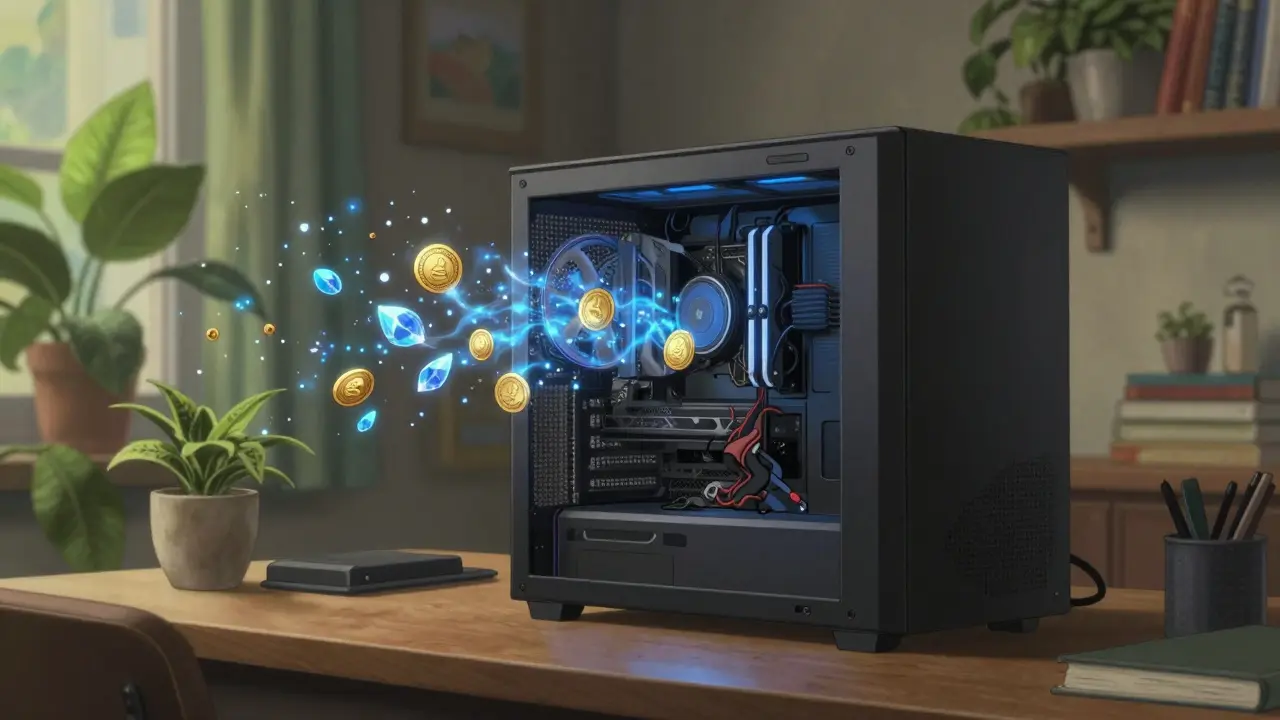
One of the biggest fears in crypto is inflation. If a network just keeps printing tokens to reward providers, the price eventually tanks. To fight this, many DePIN projects implement a "buy-and-burn" mechanism. This is a game-changer for long-term value.
Here is how it works in plain English: A customer pays for a service using a stablecoin or fiat currency. The project takes a percentage of that revenue, goes onto the open market, buys back its own tokens, and then "burns" them (sends them to an unreachable address). This permanently removes tokens from the supply. IoTeX is a decentralized network for the Internet of Things (IoT) that utilizes a buy-and-burn model to create deflationary pressure on its IOTX token has used this to reduce its supply by about 2.1% annually.
When you combine increasing demand (more customers) with a decreasing supply (burning tokens), you get a powerful economic engine that can drive price appreciation without needing a viral tweet or a celebrity endorsement.
Real-World Performance: GPU Compute and Storage
While wireless networks get a lot of attention, the most intense DePIN economics are happening in high-performance computing and storage. These sectors have a very clear "cost of goods sold" (COGS) that providers must manage.
Take Render Network is a decentralized GPU rendering platform that lets artists use a global network of computers to render 3D graphics . For a provider, the economics are a math problem: (Token Rewards + Service Fees) - (Electricity + Hardware Depreciation) = Profit. If the token price drops or the demand for rendering fades, the provider starts losing money. This creates a natural balancing act where providers move their hardware to where the demand is highest.
Similarly, Filecoin is a decentralized storage network that incentivizes users to rent out their spare hard drive space has shown that enterprise contracts are the key to stability. During the 2022 market crash, while other tokens vanished, Filecoin maintained a degree of resilience because companies were still paying for their data storage, generating millions in quarterly revenue regardless of the token's market price.

The Risks: Hardware Failures and Regulatory Walls
It's not all profit and growth. DePIN is significantly harder to pull off than a DeFi app because it deals with the "messy" physical world. Hardware breaks, electricity costs spike, and people move.
The most glaring risk is the hardware cost. Spending $2,000 on a high-end GPU node for a project that might fail in a year is a huge gamble. Many users on platforms like Reddit have complained about "inconsistent demand," where they've set up expensive gear only to earn pennies a month because the network didn't attract enough paying customers.
Then there's the law. Most countries don't have a category for "decentralized wireless hotspots." Regulatory uncertainty exists in nearly 80% of jurisdictions, which can lead to hardware being seized or projects being forced to shut down in specific regions. This makes the "global" nature of DePIN a bit of a myth-it's actually a patchwork of local legal battles.
The Road to 2027: What Actually Survives?
We are currently in a massive experimentation phase. There are dozens of projects trying to decentralize everything from weather stations to maps. But not all of them will make it. Experts suggest that up to 70% of current DePIN projects will likely fail by 2026.
The survivors will be the ones that solve the "Cold Start Problem." This is the gap between the initial token hype and the arrival of the first non-crypto customer. If a project can't find a way to make a traditional company pay for its services, the token eventually becomes a liability rather than an asset.
Looking ahead, the transition to faster blockchains is a major trend. Helium's move to Solana is a prime example, boosting transaction speeds from 10 to 65,000 per second. This allows the network to handle millions of micro-payments for data without the blockchain becoming a bottleneck.
Is DePIN a good investment compared to DeFi?
DePIN is fundamentally different because it's backed by physical assets and real-world utility. While DeFi is about financial engineering, DePIN is about infrastructure. This often means DePIN tokens have lower volatility and a more predictable value floor if the network generates actual revenue from non-crypto customers.
How do I know if a DePIN project is a scam?
Look for transparent, on-chain revenue verification. If a project claims to have massive enterprise contracts but doesn't show the payments hitting the chain or using a buy-and-burn mechanism, be cautious. Check if the token has a clear utility beyond just "staking for rewards."
What is the typical cost to start providing DePIN services?
It varies wildly. Basic IoT sensors can cost as little as $50, while high-performance computing nodes for AI rendering can exceed $2,000. Always calculate your electricity costs and expected downtime before investing in hardware.
Does the token price always go up as the network grows?
Not necessarily. If the token emission rate (how many new tokens are printed) is higher than the demand from users, the price can drop even as the network expands. This is why a sustainable emission schedule and a burn mechanism are vital.
What happens if the hardware I bought becomes obsolete?
This is a major risk. In the world of GPUs and sensors, tech evolves fast. If the network upgrades its requirements and your hardware can't keep up, your earnings will drop to zero. Treat hardware as a depreciating asset, not a permanent gold mine.




Ralph Espinosa
April 27, 2026 AT 17:11The buy-and-burn mechanism is absolutely the gold standard here!!! Without a way to offset the inflation from hardware rewards, these projects just become glorified Ponzi schemes... adding real-world demand is the only way to survive long term!!!
Robert Smith
April 28, 2026 AT 08:34DePIN is the way 🚀🔥
Bevon Findley
April 29, 2026 AT 18:20Most people miss the elegance of the cold start problem. :)
Kristi Swartz
April 30, 2026 AT 21:57people think they can get rich off a sensor but you forget that the electricity cost will eat your profit if you are not careful it is just basic math and most of these people are too lazy to calculate their overhead before buying hardware
Emily A
May 2, 2026 AT 11:49Actually, the comparison between DePIN and DeFi is slightly reductive. While the author suggests DePIN has a 'predictable value floor,' they fail to account for the systemic risk of hardware depreciation. If the network migrates to a new protocol standard, the physical assets become e-waste instantly. That is a level of risk that purely digital DeFi protocols simply do not face, making the 'stability' argument quite flawed.
Lex Harley
May 2, 2026 AT 20:05I'm kinda worried about the capEx for these nodes... like if the l1 throughput doesn't scale and we get massive latency on the reward distribution it might just break the whole feedback loop for the providrs. The hardware amortiztion is a real killer if the token dumps during a bear market
Tony Phan
May 4, 2026 AT 15:35MAN I LOVE THIS STUFF!! Totally pumped about the GPU side of things! Imagine just renting out your rig and getting paid while you sleep!! It's like a money printer but for nerds!! I'm all in on the render side of things right now because AI is literally exploding!! We are going to the moon with these hardware nodes!! Just imagine the scalability when every house has a server!! Let's goooo!!
Veronica Bago
May 6, 2026 AT 12:20It's a pretty cool concept, honestly just feels like the natural evolution of the sharing economy.
Gabby Puche
May 7, 2026 AT 14:55Keep grinding on those nodes everyone! 🌟 It takes a bit of patience to see the real returns but the tech is amazing 💖
Lynne Teperman
May 8, 2026 AT 15:03walking a tightrope between innovation and law is a wild ride indeed the legal patchwork is a colorful mess
Rachel S
May 8, 2026 AT 23:12Oh heavens, the tragedy of hardware obsolescence is simply heartbreaking! Imagine spending thousands on a high-end rig only to be told your node is now a paperweight because of a software update! It is a visceral nightmare for any serious operator! 😱 However, the shift to Solana for Helium was a masterstroke of efficiency that truly saved the ecosystem from its own limitations!
Alex Mazonowicz
May 10, 2026 AT 09:40This is such an exciting time for the web3 space!!! I really believe we will see a massive breakthrough in wireless connectivity by 2027!!! The potential is just endless!!!