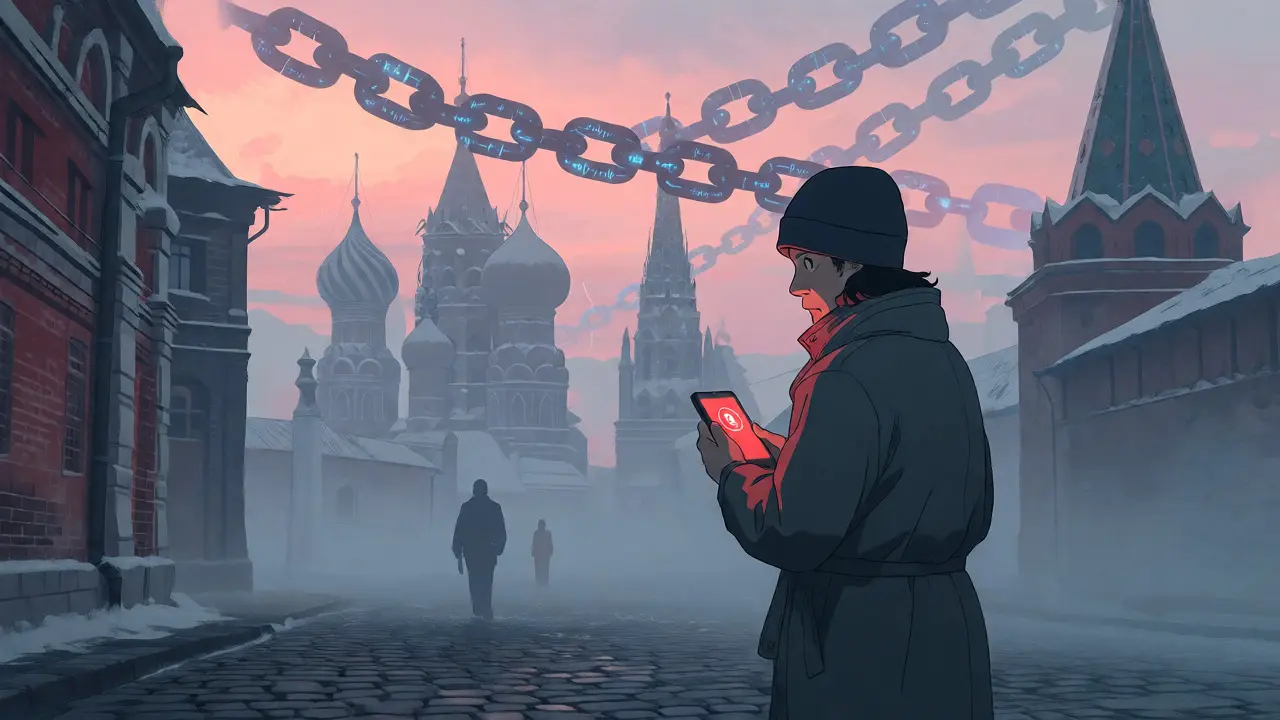
Living under international sanctions feels like being locked out of the global economy. For citizens in countries like Iran, Russia, and North Korea, traditional banking channels are often sealed shut. But cryptocurrency has become a digital lifeline-a way to send money, save wealth, and trade across borders despite heavy restrictions. However, accessing these tools is not as simple as downloading an app. Governments and financial regulators, led by the U.S. Office of Foreign Assets Control (OFAC), have built sophisticated walls to block this access.
In 2025, OFAC sanctioned 57 individuals and entities specifically for illicit cryptocurrency activities. North Korea accounted for 38% of these actions, followed closely by Russia and Iran. The number of crypto-related sanctions grew by 18% annually, with 23% of all new designations in 2024 targeting crypto activity. This means that while the desire to use crypto remains high, the path to doing so has become increasingly dangerous and complex.
Why are sanctioned countries targeted for crypto use?
Sanctions aim to isolate regimes financially. Crypto allows circumvention of these controls, making it a primary target for enforcement agencies like OFAC to prevent funding of prohibited activities or regime support.
The Rise of Decentralized Workarounds
When centralized exchanges close their doors, users don't stop; they adapt. The most common method for citizens in sanctioned regions is shifting away from regulated platforms toward decentralized finance (DeFi) protocols. Unlike centralized exchanges that require Know Your Customer (KYC) verification, DeFi platforms allow users to interact directly with smart contracts using non-custodial wallets.
Bitcoin is the dominant asset used in these transactions, accounting for 65% of identified activity by sanctioned entities. Ethereum follows with 18%, while stablecoins make up 12%. These assets are preferred because they are widely accepted and can be moved across networks without intermediary approval.
However, this freedom comes with significant risk. In July 2025, Tether conducted its largest-ever freeze of Iranian-linked funds, locking 42 cryptocurrency addresses tied to the Iranian exchange Nobitex. This event shocked many users who believed their funds were safe on-chain. It highlighted a critical vulnerability: even if you control your wallet, the tokens inside might be frozen by the issuer if they comply with sanctions.
- Asset Choice Matters: Bitcoin is harder to freeze than stablecoins issued by centralized companies.
- Network Selection: Users increasingly move assets to networks like Polygon to swap into less-regulated stablecoins like DAI.
- Wallet Hygiene: Using fresh, non-linked wallets reduces the chance of association with known sanctioned addresses.
Successor Platforms and the Hydra Effect
Regulators often think shutting down one platform stops the flow. In reality, it creates a hydra effect-cut off one head, and two more grow back. A prime example is the Russian exchange Garantex. After OFAC sanctioned Garantex in 2022 for processing millions in illicit transactions, the exchange didn't disappear. Instead, it evolved.
By March 2025, after U.S. Secret Service partnerships seized Garantex's domain and froze over $26 million in crypto, the operation had already migrated its user base to a successor platform called Grinex. This pattern is common among sanctioned entities. They create mirror sites, change domains, or launch entirely new brands that replicate the core functions of the original service.
| Feature | Centralized Exchange (e.g., Binance) | Successor Platform (e.g., Grinex) |
|---|---|---|
| KYC Requirements | Strict identity verification | Minimal or no verification |
| Regulatory Compliance | High (blocks sanctioned IPs) | Low (operates in gray zones) |
| User Trust | High (established reputation) | Low (risk of scams/rug pulls) |
| Access for Sanctioned Users | Blocked | Often permitted |
These successor platforms often operate through offshore hubs like Dubai or via Telegram-based services like MKAN Coin. While they provide access, they carry extreme risks. Without regulatory oversight, there is no recourse if the platform disappears or steals funds. Transparency International Russia exposed in September 2025 how these systems have morphed into decentralized money laundering networks, supported by payment processors like Exved.
The Role of Mixers and Privacy Tools
To avoid detection, many users turn to privacy-enhancing technologies, particularly mixers. Mixers pool cryptocurrencies from multiple users and redistribute them, breaking the link between the sender and receiver. Tornado Cash was the most famous example, but its sanctioning in 2022 forced users to seek alternatives.
In 2024, five major enforcement actions targeted Tornado Cash-style services. OFAC’s first-ever sanction against a DeFi protocol in January 2025, which froze $150 million in assets, signaled a new era of aggressive monitoring. Now, simply interacting with a sanctioned mixer can lead to your own funds being frozen by compliant exchanges.
Despite this, demand persists. Users in sanctioned countries rely on these tools to obscure transaction trails. However, the effectiveness of mixers is diminishing as blockchain analytics firms like Chainalysis and TRM Labs improve their ability to trace mixed funds. TRM Labs data showed an 11% drop in crypto inflows to Iran in the first half of 2025, suggesting that enforcement is having some impact, even if it hasn’t stopped activity entirely.

Government Responses and Taxation
Interestingly, some sanctioned governments are not trying to ban crypto-they’re trying to tax it. In August 2025, Iran enacted the Law on Taxation of Speculation and Profiteering, imposing capital gains tax on cryptocurrency trading for the first time. This positions crypto alongside gold, real estate, and forex as taxable speculative assets.
This shift reveals a dual strategy: restrict access to foreign-controlled exchanges while capturing value from domestic crypto usage. For citizens, this adds another layer of complexity. You must navigate both international sanctions and local tax laws. Failure to comply can result in penalties from your own government, while violating OFAC rules can lead to asset freezes globally.
Risks and Realities for Everyday Users
For the average citizen in a sanctioned country, accessing crypto is not just a technical challenge-it’s a legal minefield. Here are the key realities:
- Account Freezes Are Common: Even if you use a decentralized wallet, moving funds to a centralized exchange for cash-out can trigger KYC checks that reveal your location.
- Scams Target Vulnerable Users: Desperation makes users susceptible to fake exchanges, phishing sites, and fraudulent investment schemes promising easy access.
- Legal Liability: Violating sanctions can result in criminal charges in some jurisdictions, even if the user is unaware of the rules.
- Technical Complexity: Navigating DeFi requires understanding gas fees, slippage, bridge risks, and smart contract vulnerabilities-knowledge gaps that lead to lost funds.
The ShapeShift case illustrates how easily compliance fails. In 2025, the defunct Swiss exchange paid $750,000 to OFAC for allowing users from Cuba, Iran, Sudan, and Syria to trade. OFAC found ShapeShift had no sanctions compliance program. This shows that even reputable platforms can inadvertently facilitate illegal access, highlighting the need for users to verify exchange policies carefully.

Global Jurisdictions and Indirect Access
Some users attempt to bypass restrictions by routing transactions through crypto-friendly jurisdictions. Singapore, with its strong anti-money laundering (AML) regulations and no capital gains tax, attracts sophisticated users. El Salvador’s adoption of Bitcoin as legal tender offers 0% tax on foreign crypto income. The UAE, particularly Dubai, provides a tax-free environment under the VARA authority, hosting over 1,000 crypto firms.
However, these jurisdictions also enforce strict AML/KYC rules. Simply having an account in Dubai doesn’t mean you can hide your true residence. Exchanges in these regions often use IP geolocation, device fingerprinting, and document verification to detect users from sanctioned countries. Attempting to deceive these systems can lead to permanent bans and fund confiscation.
The Future: An Arms Race
The landscape is evolving rapidly. Enforcement agencies are expanding their reach into DeFi, while users are developing more sophisticated evasion techniques. The Department of State’s offer of up to $5 million for information leading to the arrest of Garantex executive Aleksandr Mira Serda shows the high stakes involved.
As blockchain analytics improve, the window for anonymous transactions shrinks. Yet, the persistent operation of sanctioned exchanges and rapid user adaptation suggest that complete prevention is unlikely. The future will likely see more hybrid models-partially decentralized platforms that offer enough privacy to evade basic filters but lack the robustness of fully decentralized networks.
Is it illegal for citizens in sanctioned countries to use crypto?
It depends on the jurisdiction. In many cases, using crypto itself isn't banned locally, but accessing U.S.-linked financial services or violating OFAC sanctions is illegal under U.S. law, which can affect global access.
Can I use a VPN to access crypto exchanges?
VPNs can mask your IP address, but modern exchanges use additional methods like device fingerprinting and KYC documents to detect true location. Relying solely on a VPN is risky and often ineffective.
What happens if my crypto wallet gets sanctioned?
If your wallet is added to the SDN List, compliant exchanges will freeze any funds you try to deposit. You may lose access to those assets permanently unless you can prove innocence through legal channels.
Are decentralized exchanges (DEXs) safe from sanctions?
Not necessarily. While DEXs don't hold custody, OFAC has sanctioned specific DeFi protocols and token lists. Interacting with sanctioned contracts can still lead to issues when withdrawing to centralized platforms.
How do I know if an exchange is compliant with sanctions?
Check the exchange's terms of service and sanctions policy. Reputable platforms explicitly list restricted countries. If a platform claims to accept everyone without verification, it may be operating illegally and poses higher security risks.