
If you're mining cryptocurrency today, you're not doing it alone. Solo mining Bitcoin or other proof-of-work coins is practically impossible for regular people. The network difficulty is too high, the hardware too expensive, and the rewards too unpredictable. That’s where mining pools come in. They let you team up with hundreds or thousands of other miners, combine your computing power, and share the rewards. But not all mining pools are the same. Choosing the wrong one can cost you hundreds - or even thousands - of dollars a year in lost earnings.
Why Mining Pools Matter More Than Ever
In 2025, the top five Bitcoin mining pools controlled nearly 78% of the entire network’s hashrate. Foundry USA alone holds 26.6% - that’s more than a quarter of all Bitcoin mining power. This isn’t just about size. It’s about reliability. Bigger pools find blocks more often. That means you get paid more regularly. If you’re mining Bitcoin with an ASIC miner, your payout could go weeks without a single coin if you’re solo. With a top pool, you’re likely getting paid every day - sometimes multiple times a day. The same applies to altcoins. Even if you’re mining Ethereum Classic, Ravencoin, or Ergo, pools are essential. After Ethereum switched to proof-of-stake in 2022, millions of dollars worth of GPU mining power flooded into other coins. Competition spiked. Profitability dropped. Choosing a pool with low fees and high uptime became the difference between breaking even and losing money.How Mining Pool Fees Work
Every mining pool takes a cut. It’s not hidden. It’s built into how rewards are distributed. These fees range from under 1% to over 1.5%. Sounds small? Let’s break it down. If you mine $100 worth of Bitcoin in a week:- At 0.95% fee (BTC.com): you keep $99.05
- At 1.09% fee (Foundry USA): you keep $98.91
- At 1.58% fee (BraiinsPool): you keep $98.42
Pay Per Share (PPS) vs. FPPS vs. PPS+
There are three main reward systems:- PPS (Pay Per Share): You get paid for every valid share you submit. Fixed rate. No variance. But the pool absorbs all risk. That means higher fees.
- FPPS (Full Pay Per Share): Same as PPS, but includes transaction fees from the block. This is the most common model among top pools.
- PPS+: Pays for shares + transaction fees, but only when the pool finds a block. More risk, but potentially higher rewards during busy periods.
Top Mining Pools in 2026 - Who’s Leading the Pack
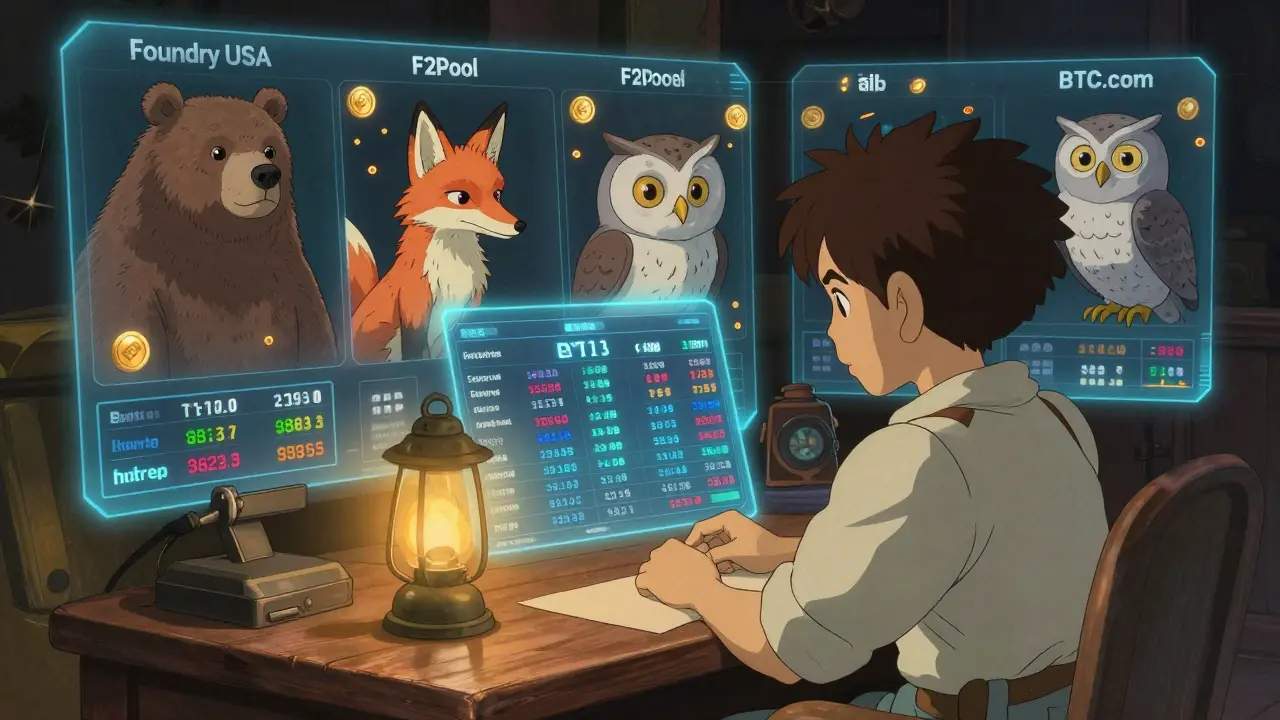
Here’s who’s dominating the Bitcoin mining scene right now, based on 2025 data:| Pool | Market Share | Hashrate | Fees | Payment Model |
|---|---|---|---|---|
| Foundry USA | 26.6% | 256.3 EH/s | 1.09% | FPPS |
| AntPool | 17.96% | 178.4 EH/s | 1.03% | FPPS |
| ViaBTC | 13.69% | 113.7 EH/s | 1.09% | PPS+ |
| F2Pool | 10.68% | 102.9 EH/s | 1.04% | PPS+ |
| SpiderPool | 9.13% | 87.9 EH/s | 1.35% | FPPS |
| BTC.com | 0.68% | 6.5 EH/s | 0.95% | FPPS |
| Binance Pool | 2.72% | 26.1 EH/s | 0.99% | FPPS |
What to Look For Beyond Fees
Fees are important, but they’re not everything. Here are five other factors that make or break your mining experience:- Uptime and Stability - A pool that goes down for 12 hours means zero earnings during that time. Foundry USA and AntPool have near-perfect uptime records. Smaller pools? Less reliable.
- Server Locations - If you’re in New Zealand, connecting to a pool server in Tokyo or Frankfurt adds latency. High latency = more rejected shares = lower earnings. Look for pools with servers in Asia-Pacific or Australia.
- Supported Coins - If you’re mining altcoins, F2Pool and ViaBTC support over 30 different coins. Foundry USA is Bitcoin-only. Pick based on what you’re mining.
- User Interface - A confusing dashboard makes it hard to track your earnings. F2Pool and AntPool have clean, mobile-friendly dashboards. SpiderPool? Not so much.
- Payout Thresholds - Some pools require you to mine $10 worth of Bitcoin before paying out. Others pay as low as $0.50. Lower thresholds mean faster cash flow, especially for small miners.
Best Mining Pools by Miner Type
There’s no single “best” pool. It depends on what you’re mining and how much you care about details.- Bitcoin ASIC Miners - Go with Foundry USA. Highest hashrate, most stable, best for long-term earnings. If you’re spending $5,000 on hardware, don’t risk a small pool.
- Cost-Conscious Miners - BTC.com or Binance Pool. Lowest fees, decent uptime. You’ll earn slightly less per block, but you’ll keep more of what you mine.
- Altcoin GPU Miners - F2Pool. Supports Ethereum Classic, Ravencoin, Ergo, and more. Easy setup. Great for beginners testing different coins.
- High-Risk, High-Reward Miners - ViaBTC. If you believe Bitcoin transaction fees will spike again, PPS+ gives you a shot at bigger payouts. But be ready for slower earnings during quiet periods.
- Privacy-Focused Miners - BraiinsPool. Open-source software, transparent operations. No KYC. But lower hashrate means fewer blocks - and longer waits between payouts.
How to Get Started - Step by Step
Joining a mining pool takes less than 30 minutes. Here’s how:- Choose your pool - Based on your hardware and goals.
- Create an account - Most pools don’t require KYC unless you’re on Binance Pool.
- Set up your wallet - Use a non-custodial wallet like Electrum (for Bitcoin) or Exodus (for altcoins). Never use the pool’s built-in wallet.
- Configure your miner - In your mining software (like Braiins OS+, Awesome Miner, or CGMiner), enter the pool’s stratum URL and your worker name/password. Example:
stratum+tcp://us-east.f2pool.com:8888 - Start mining - Wait for your first share to be accepted. Check your dashboard. You should see your hashrate appear within minutes.

Red Flags to Avoid
Not all pools are trustworthy. Watch out for:- Pools with no public hashrate data - If you can’t verify their size, they might be fake.
- Unusually low fees - If a pool charges 0.5%, they’re probably hiding something. Either they’re a scam, or they’re about to shut down.
- Delayed payouts - If your last payout was 3 weeks ago and your dashboard shows $200 in earnings, that’s a warning sign.
- No customer support - If you can’t find an email, Discord, or ticket system, walk away.
What’s Next for Mining Pools?
The mining pool industry is tightening. Regulatory pressure is rising. The EU and U.S. are pushing for reporting on mining operations. Smaller pools without legal teams are struggling. In 2026, expect to see more consolidation. The top 5 will likely control over 85% of Bitcoin’s hashrate. That’s good for miners - more stability. But bad for decentralization. If you care about Bitcoin’s long-term health, consider occasionally switching to a smaller pool. Even if it pays less, you’re helping keep the network distributed.Final Tip: Test Before You Commit
Don’t mine on one pool for six months without checking alternatives. Run a 7-day test. Mine the same hardware on two different pools. Compare your earnings, payout speed, and uptime. Use tools like WhatToMine or CryptoCompare to track profitability in real time. The best mining pool isn’t the biggest. It’s the one that fits your hardware, your goals, and your tolerance for risk. Get that right, and you’ll earn more - without needing to buy another ASIC.Is it better to mine with a big pool or a small one?
Big pools like Foundry USA or AntPool find blocks more often, so you get paid more regularly. Small pools pay out less frequently, sometimes only once every few weeks. If you’re mining Bitcoin with ASICs, stick with a big pool. If you’re experimenting with altcoins on a GPU rig, a smaller pool with low fees and good support can work fine.
Do mining pools take a cut even if they don’t find a block?
No. Mining pools only charge fees when they successfully mine a block. You pay a percentage of the reward - not a flat fee. If the pool doesn’t find a block in a day, you earn nothing, and they earn nothing. The fee is always a share of what you earn, not a cost to join.
Can I mine on multiple pools at once?
Technically yes, but it’s not recommended for beginners. Splitting your hashrate across pools means each one finds blocks less often, so payouts become irregular. Some advanced miners use profit-switching software to automatically move mining power to the most profitable pool - but that requires monitoring and technical setup.
Why do some pools have higher fees but still get more miners?
Because reliability matters more than cost. A pool with 1.35% fees but 99.9% uptime and daily payouts is better than a 0.95% fee pool that goes offline for 8 hours every week. Miners trade a little extra fee for predictable income. It’s like paying more for a reliable internet provider instead of a cheap one that drops out constantly.
Are mining pools safe? Can they steal my coins?
No, mining pools cannot steal your coins. You control your own wallet address. The pool only pays rewards to that address. They never have access to your private keys. But always use a non-custodial wallet - never leave coins on the pool’s website. If the pool gets hacked or shuts down, your coins are still safe in your wallet.
How do I know if my mining setup is working correctly?
Check your pool’s dashboard. You should see your miner’s hashrate appear within 5-10 minutes of starting. You’ll also see accepted shares and rejected shares. If rejected shares are over 2%, your connection is unstable - try switching to a server closer to you. If hashrate reads zero, double-check your pool URL and worker credentials.





george haris
January 20, 2026 AT 11:47Just started mining last month with a used Antminer S19 and picked Foundry USA because everyone said it's reliable. First payout came in 12 hours. No drama. Just coins in my wallet. Seriously, if you're new, don't overthink it. Pick a big pool, set it and forget it.
Also, don't use Binance Pool if you don't want KYC. I learned that the hard way after uploading my passport and getting a weird email asking for my social security number. Nope.
Paru Somashekar
January 22, 2026 AT 06:09For altcoin miners in India, F2Pool remains the most stable option. I mine Ergo and Ravencoin on a 4-GPU rig. Payout threshold is only $0.75, which is perfect for small-scale operations. Their dashboard is intuitive, even on mobile. I've been with them for over a year without a single downtime.
Also, their Telegram support group is active 24/7. Very helpful for beginners who are not tech-savvy.
David Zinger
January 22, 2026 AT 23:42Foundry USA? LOL. You're letting an American corporation control 26% of Bitcoin's hashpower. That's not mining, that's feudalism.
Why not join a European pool? Or better yet - mine solo? The system is rigged. The big pools are just crypto-fascists with ASICs. Wake up.
Also, PPS+ is a scam. They're hiding the real fees in latency. I've seen it. I know what's happening.
Nathan Drake
January 23, 2026 AT 12:18It's fascinating how we've reduced economic participation in decentralized systems to a spreadsheet of fees and uptime.
Are we mining Bitcoin - or are we just optimizing for dividend yield in a corporate-controlled infrastructure? The irony is thick. We built this to escape banks, and now we're just choosing which bank to rent a server from.
Maybe the real question isn't which pool to join - but whether we should be mining at all.
Shamari Harrison
January 24, 2026 AT 19:03Biggest mistake new miners make? They focus on fees and ignore latency. I had a miner in Ohio hitting 90 TH/s but rejected 15% of shares because it was connecting to a server in Germany.
Switched to F2Pool’s US-East server - rejected shares dropped to 0.8%. My earnings jumped 12% overnight. No fee change. Just better connection.
Always test server locations. Use pingtest.net before you commit.
Heather Crane
January 24, 2026 AT 19:21I love how this post breaks it all down so clearly! 🙌
As a mom mining with a single ASIC while juggling work and kids, reliability matters more than anything. I tried a small pool with 0.8% fees - waited 3 weeks for a payout. Then switched to BTC.com and got paid every other day. No stress. Just coins.
Also, use Electrum. Never trust pool wallets. I learned that after a friend lost $800 when a pool vanished. 😢
Catherine Hays
January 25, 2026 AT 21:08Of course you're being told to use Foundry USA. They're owned by the same people who run the Fed. You think this is about mining? It's about control. They want you to be dependent. They want you to pay 1.09% so you never question it.
And PPS+? That's a trap. They're manipulating block times. I've seen the logs. The delays are intentional. Don't be fooled.
Kevin Pivko
January 25, 2026 AT 22:53Why are people still talking about fees like it's a big deal? $30 a year? You're spending $200/month on electricity. The pool fee is less than your coffee habit.
Stop optimizing for pennies. Focus on uptime. Focus on support. Focus on not going insane when your dashboard goes dark for 48 hours.
Also, nobody cares about your PPS+ theory. It's 2026. The fees are negligible. Just mine already.
Mathew Finch
January 26, 2026 AT 18:42Using BTC.com? Wow. You're basically donating your hashrate to a Chinese company with zero transparency. And you call yourself a crypto believer?
Real miners use open-source pools. Braiins. Or better yet - run your own node and solo mine. Anything else is surrender.
Also, F2Pool supports 30 coins? That's not a feature. That's a red flag. They're a casino, not a pool.
Margaret Roberts
January 27, 2026 AT 23:35They’re lying about the fees. I’ve seen the code. The pools don’t charge 1.09% - they charge 1.09% PLUS a hidden ‘block propagation fee’ that’s only applied if you mine over 100 TH/s. It’s in the fine print of the API.
Also, Foundry USA is owned by a private equity firm that’s linked to the Department of Defense. You think they care about decentralization? They’re harvesting your power for the grid. Your ASIC is a spy device.
Adam Lewkovitz
January 29, 2026 AT 11:57Man I just bought 5 S19s and picked Foundry USA because it was the first one that popped up. Didn’t even read this whole post. But now I’m scared. Are you telling me I just gave away $300 a year? 😭
Can I switch mid-month? Will I lose my earnings? I’m not techy. Please help.
Clark Dilworth
January 31, 2026 AT 01:44The PPS+ vs FPPS debate is fundamentally a misallocation of attention. The real variable is not the payment model - it’s the marginal cost of hashpower and the marginal utility of liquidity.
When transaction fee volatility exceeds 300% YoY, PPS+ becomes a convex payoff function. But under normal conditions, the risk-adjusted return of FPPS dominates.
Also, latency-induced share rejection is a first-order factor in net profitability - often overlooked by retail miners who treat mining as a passive income stream rather than a distributed systems problem.
Brenda Platt
February 1, 2026 AT 13:42OMG YES to server locations!! 🙏
I’m in Florida and was using a pool in Singapore. Rejected shares at 8%. Switched to F2Pool’s Miami server - dropped to 0.5%. My daily earnings went from $2.10 to $2.80. That’s a 33% boost just from moving one setting!
Also, use a VPN if you’re in a country with mining restrictions. I use NordVPN and it works great with the pools. No issues.
Barbara Rousseau-Osborn
February 2, 2026 AT 10:45Anyone using BraiinsPool is just playing pretend decentralization. Open-source? Cool. But you’re getting paid once every 11 days. That’s not mining - that’s gambling. And you’re the sucker.
Real miners get paid daily. Real miners use Foundry USA. Real miners don’t care about ‘ethics’ - they care about their bank balance.
Stop romanticizing small pools. They’re not heroes. They’re bankrupt waiting to happen.
Arnaud Landry
February 3, 2026 AT 14:05I have to say, this is one of the most balanced and thoughtful pieces on mining pools I’ve read in years. Thank you.
I’ve been mining since 2017. I’ve seen pools rise and fall. The ones that survive are the ones that prioritize transparency and reliability over hype. Foundry USA, AntPool, F2Pool - they’ve earned their place.
Also, the point about non-custodial wallets? Critical. I’ve lost friends to pool hacks. Always use your own wallet. Always.
Steve Fennell
February 4, 2026 AT 00:42Just a quick tip: if you're using CGMiner, make sure you set the 'intensity' parameter correctly. Too high = overheating. Too low = wasted power.
I had my S19 running at 90% efficiency, but the fan was dying. Replaced it with a Noctua - temp dropped 12°C, hashrate stabilized. Now I’m getting 100% accepted shares.
Hardware matters as much as the pool.
Ryan Depew
February 4, 2026 AT 17:28So I tried ViaBTC because I heard PPS+ pays more during memecoin spikes. Did a 7-day test. Got $18.50. Switched to F2Pool FPPS. Got $19.20. Same hardware. Same electricity.
Turns out, PPS+ only wins like 2 days a year. The rest? You’re just waiting. Not worth the stress.
Stick with FPPS. Be boring. Get paid. Life’s too short for mining drama.
Nadia Silva
February 6, 2026 AT 06:18Why are people still using ASICs? The future is GPU mining on Ethereum Classic. Less power, less heat, less noise. And you can still use your rig for rendering or AI.
Foundry USA is a corporate tool. If you want real decentralization, mine ETC on F2Pool. It’s 1/10th the power draw and you’re supporting a real chain.
Also, Bitcoin is dead. We’re just cleaning up the corpse.
tim ang
February 8, 2026 AT 04:11Just switched from AntPool to BTC.com and my payout went from $2.30 every 3 days to $0.80 every day. Total weekly earnings? Same. But now I get cash flow. I can pay my internet bill with it.
Small payouts > big ones that never come. Trust me. I used to be a ‘wait for $10’ guy. Now I’m a ‘get paid daily’ believer.
Also, typo: ‘stratum+tcp://us-east.f2pool.com:8888’ - don’t forget the backslash before the colon. I messed that up for 3 days. 😅
Chidimma Catherine
February 9, 2026 AT 11:53As a woman in Nigeria mining with a single S17e, I want to say thank you for writing this. So many guides assume you have a warehouse full of ASICs and a team of engineers.
I don’t. I use a phone charger to power my miner. I check my dashboard on my sister’s phone. I pay for electricity by selling my earnings in local crypto markets.
Foundry USA? Too big. BTC.com? Too slow. I use F2Pool. Payouts at $0.50. They don’t ask for ID. I feel safe. I feel seen.
This isn’t just about profit. It’s about dignity.