

The Big Question: Legal Title vs. Digital Entry
Before you write a single line of code, you have to answer one critical question: does the token actually equal legal ownership, or is it just a contractual claim? This distinction determines whether your project is a revolutionary financial tool or a legal nightmare waiting to happen. Most projects fall into one of three structural buckets:- On-chain: Everything lives on the distributed ledger. The legal rights are embedded directly into the token. This is the gold standard but is incredibly hard to achieve because most governments still require paper deeds or official registries.
- Off-chain: The token is basically a digital receipt. The actual ownership stays in a traditional legal framework, like a land registry or a vault of physical platinum.
- Hybrid: A mix of both. You might track the transaction history and ownership shifts on-chain, while keeping the sensitive, legally binding documents in a traditional registry.
Choosing Your Legal Wrapper: SPV vs. Direct Tokenization
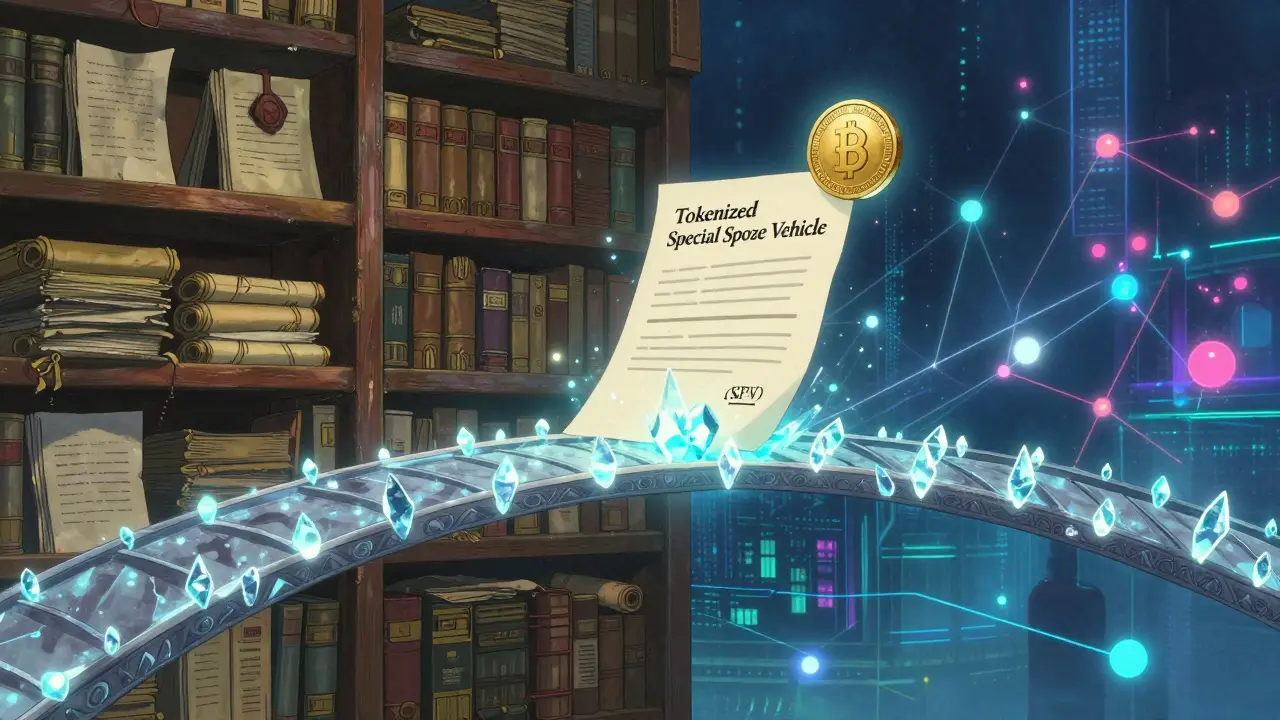
You can't just "upload" a house to the blockchain. You need a "wrapper"-a legal entity that bridges the physical world and the digital ledger.The most common approach is the Tokenized Special Purpose Vehicle (SPV) is a legal entity, such as a trust or private limited company, created solely to hold a specific asset and issue tokens representing interests in that entity . Think of it like this: the SPV owns the building, and the tokens represent shares in the SPV. This is generally the safest bet because it fits neatly into existing securities laws. If you use a Series LLC, you can even isolate different assets so a problem with one property doesn't bankrupt the others.
On the other hand, Direct Asset Tokenization attempts to make the token a direct claim on the asset itself. While it sounds cleaner, it is rarely used. Why? Because it's a regulatory minefield. If a platform using direct tokenization collapses, token holders often find they are just "unsecured creditors" rather than asset owners. One failed art project proved this when investors lost everything because the contractual protections weren't there to back up the digital tokens.
| Feature | Tokenized SPV (Indirect) | Direct Asset Tokenization |
|---|---|---|
| Legal Complexity | Moderate (Uses existing laws) | High (Requires new legal precedents) |
| Regulatory Fit | High (Fits securities models) | Low (Often clashes with title laws) |
| Insolvency Protection | Strong (Asset is isolated in SPV) | Weak (Risk of being an unsecured creditor) |
| Common Use Case | Real Estate, Private Credit | Experimental Art/Collectibles |
Navigating Global Regulations: EU vs. USA
Where you launch your project changes everything. The legal requirements in Brussels are worlds apart from those in Washington D.C.In the European Union, the MiCA (Markets in Crypto-Assets) is a comprehensive EU regulation that provides a unified legal framework for crypto-assets, including those tied to commodities or real estate income streams . If you are operating in the EU, your first job is to decide if your token is a "security" or a "crypto-asset." Get this wrong, and you'll be non-compliant with either MiCA or traditional securities law. You also have to deal with the "Travel Rule," which means every token transfer must carry information about who sent it and who is receiving it to stop money laundering.
The United States takes a different, more fragmented approach. Instead of one big law like MiCA, the SEC uses the Howey Test is a legal test used by the U.S. courts to determine whether a transaction qualifies as an "investment contract" and thus a security . If your token meets the Howey criteria, you must either register it with the government or find a legal exemption, such as Regulation D (for accredited investors) or Regulation S (for non-U.S. persons). Because the U.S. is so aggressive with enforcement, many RWA projects avoid direct U.S. exposure entirely.
The Cost of Doing It Right
Tokenization isn't just about writing a smart contract in Solidity. A huge chunk of your budget needs to go into legal engineering. Industry data shows that successful projects spend roughly 25% to 35% of their initial development resources just on legal structuring. If you're planning a serious RWA project, expect a timeline and budget like this:- Regulatory Analysis (3-6 months): You'll need a formal legal opinion to determine if your token is a security. Depending on the asset, this can cost between $50,000 and $250,000.
- Documentation Phase (200-400 hours): Your lawyers will draft the SPV formation documents, custody agreements, and investor contracts. This is where the actual "rights" are defined.
- Compliance Integration: Setting up KYC (Know Your Customer) and AML (Anti-Money Laundering) systems. This isn't optional; it's the only way to attract institutional capital.
Practical Pitfalls to Avoid
Many founders treat tokenization as a technical problem. They think, "If I can code the fractional ownership, the law will follow." This is a recipe for disaster. One major pitfall is ignoring the "Oracle Problem" in a legal sense. How does the blockchain know that a property was actually sold in the real world? Without a legally recognized bridge-like a licensed custodian or a trustee-the ledger entry is meaningless. You need a mechanism where the ledger is recognized by the court as evidence of title, or you need a contract that says the token holder is the beneficial owner of the asset held by the SPV. Another risk is regulatory arbitrage. Trying to launch in a "crypto-friendly" jurisdiction like the UAE or Singapore while targeting investors in the EU or US can lead to massive fines. You must align your legal wrapper with the laws of the country where your investors live, not just where your company is registered.The Future of Digital Assets
We are moving toward a world where the majority of commercial real estate and private credit will be tokenized. Experts predict that by 2025, 40% of commercial real estate transactions in major European markets will involve tokenization, thanks to the clarity provided by MiCA. We are also seeing the rise of standardization. The International Swaps and Derivatives Association (ISDA) is working on templates to make the legal documentation for RWAs as standard as a mortgage application. Once these templates become common, the cost of launching RWA projects will drop, and liquidity will skyrocket. For now, the rule remains: build your legal foundation before you build your token.What is the difference between a security token and an RWA token?
RWA is a broad category of assets (real estate, art, gold) that are tokenized. A security token is a legal classification. Many RWA tokens are classified as security tokens because they represent an investment in an asset with the expectation of profit, but not all RWAs are securities (e.g., a token representing a physical gram of gold might be treated as a commodity).
Why is an SPV necessary for tokenization?
An SPV acts as a legal bridge. Since most land registries or stock exchanges don't recognize blockchain addresses as owners, the SPV owns the asset in the "real world" while issuing digital tokens that represent a legal interest in that SPV. This protects investors by isolating the asset from the parent company's liabilities.
Can I tokenize a house without a lawyer?
Technically, you can mint a token that says "I own this house." However, legally, that token is worthless unless you have a signed contract or a deed transfer that links the token to the property. Doing this without a legal framework puts you at risk of securities law violations and ensures the token has no enforceable value.
What happens if the tokenization platform goes bankrupt?
This depends entirely on the structure. In a well-structured SPV model, the asset is held separately from the platform. If the platform fails, the SPV still owns the asset, and token holders still have a claim to it. In "direct" models without proper wrappers, token holders are often treated as unsecured creditors, meaning they might lose everything.
Does MiCA apply to all RWA projects in Europe?
MiCA provides a broad framework for crypto-assets, but there is a key distinction: if an RWA token is classified as a "financial instrument" (a security) under EU law, it may fall under MiFID II rather than MiCA. Projects must perform a careful classification analysis to determine which regulation applies.






Rob Mitchell
April 14, 2026 AT 06:00SPVs are definitely the way to go for scaling these projects safely.
Kelly Cantrell
April 15, 2026 AT 11:23Funny how they mention the SEC just being "aggressive"
It's obviously just a way for the government to keep the little guy from actually owning real assets without a middleman taking a cut. They want total control over the registry so they can freeze your assets whenever they feel like it.
Will Dixon
April 17, 2026 AT 01:46jus makes sense to use the legal wrappers since the laws are so old lol
Prasanna Shembekar
April 18, 2026 AT 09:36omg the cost of legal is just heartbreaking!!! why is it so expensive just to start something new😭
Lela Singh
April 20, 2026 AT 08:12The MiCA framework is a total game changer for liquidity in Europe! It creates such a vibrant path for institutional money to flow into tokenized real estate without the usual regulatory dread.
Carroll Foster
April 21, 2026 AT 13:08Oh sure, let's just trust a "licensed custodian" to be the magic bridge between a decentralized ledger and a dusty paper deed in a government basement. Pure poetry in inefficiency right there.
Hope Johnson
April 23, 2026 AT 06:34When we contemplate the intersection of digital scarcity and physical permanence, we must recognize that the token is not merely a financial instrument but a conceptual shift in how humanity perceives ownership. By bridging the gap through an SPV, we are essentially creating a digital twin of a legal reality, which suggests that our traditional notions of "title" are merely precursors to a more fluid, programmable form of property rights that will eventually dissolve the need for centralized registries entirely as trust is shifted from humans to mathematics.
Amanda Faust
April 24, 2026 AT 01:54everyone knows the Howey test is outdated and doesn't actually fit digital assets properly
ssjuul z
April 25, 2026 AT 11:30Absolutely agree on the legal foundation part! 🚀 Get the plumbing right first or the whole house falls down!
Jessie Tayaban
April 26, 2026 AT 03:58i literally can't even imagine paying 250k just for a legal opinion!! thats just wildddd honestly
Rebecca Violette
April 27, 2026 AT 07:48my last project failed because of this stuff and now i just feel totally drained and defeated by the system
Omotola Balogun
April 29, 2026 AT 02:37The distinction between MiCA and MiFID II is actually a bit more nuanced than presented here. Many people mistake the two, but if the asset's primary purpose is investment, the security laws usually trump the crypto-asset laws regardless of the wrapper used. It's a common mistake in the early stages of project development in the EU.
Terrance Hausmann
April 29, 2026 AT 16:39It's a lot to take in, but taking it step by step is the only way to ensure no one gets hurt financially in the long run. If we can just keep the conversation open and help the newcomers understand that the "slow way" is the "safe way," we can avoid those horror stories about unsecured creditors and lost assets that we've seen in the past decade of crypto experimentation.
Artavius Edmond
May 1, 2026 AT 13:46Just vibing with the idea of owning a slice of a Picasso, sounds pretty chill if the legal stuff is actually handled.
Agnessa Dale
May 3, 2026 AT 00:09So exciting to see the industry moving toward standardization with ISDA!
EDOZIEM MICHAEL
May 4, 2026 AT 12:55money is just energy moving through different forms and tokens are just a new way to channel that energy
Akshay Gorad
May 6, 2026 AT 11:00The use of a Series LLC for asset isolation is a prudent strategy for risk management.
Jonathan Chamma
May 7, 2026 AT 16:05I love how this breaks down the complex bits into something we can all wrap our heads around. It's like a cozy map for a very scary forest. Let's all try to be patient with each other as we learn these funky new rules together, because the goal is to make wealth more accessible for everyone, not just the folks with a million-dollar head start.