You missed the main window. If you were waiting to claim your share of the Midnight Network a large-scale distribution of NIGHT tokens to eligible cryptocurrency holders across multiple blockchains, the clock stopped ticking on October 4, 2025. This wasn't just another quick cash grab; it was one of the most complex and widely distributed events in crypto history, handing out 24 billion NIGHT tokens to nearly 34 million addresses. But what happens now? Did you lose everything if you didn't click 'claim' in time?
The short answer is no, but the path forward has changed. The initial phase, known as the "Glacier Drop," is closed. However, the Midnight ecosystem designed this rollout with three distinct phases to ensure maximum community participation and network security. Understanding exactly how the distribution worked, why it ended when it did, and where the unclaimed tokens are going is crucial for anyone holding assets on Bitcoin, Ethereum, or Cardano who wants to stay involved.
What Was the Midnight Glacier Drop?
To understand the current state of the NIGHT token, you first need to grasp the scale of the event. The Glacier Drop was not a random giveaway. It was a strategic move to bootstrap a decentralized privacy network built on the Cardano ecosystem a blockchain platform founded by Charles Hoskinson that focuses on peer-reviewed research and sustainable development. Midnight Network aims to solve a major problem in crypto: the tension between utility and privacy. Traditional blockchains like Bitcoin are transparent, which is great for auditability but bad for sensitive data. Midnight offers "rational privacy," allowing users to control what they reveal and to whom.
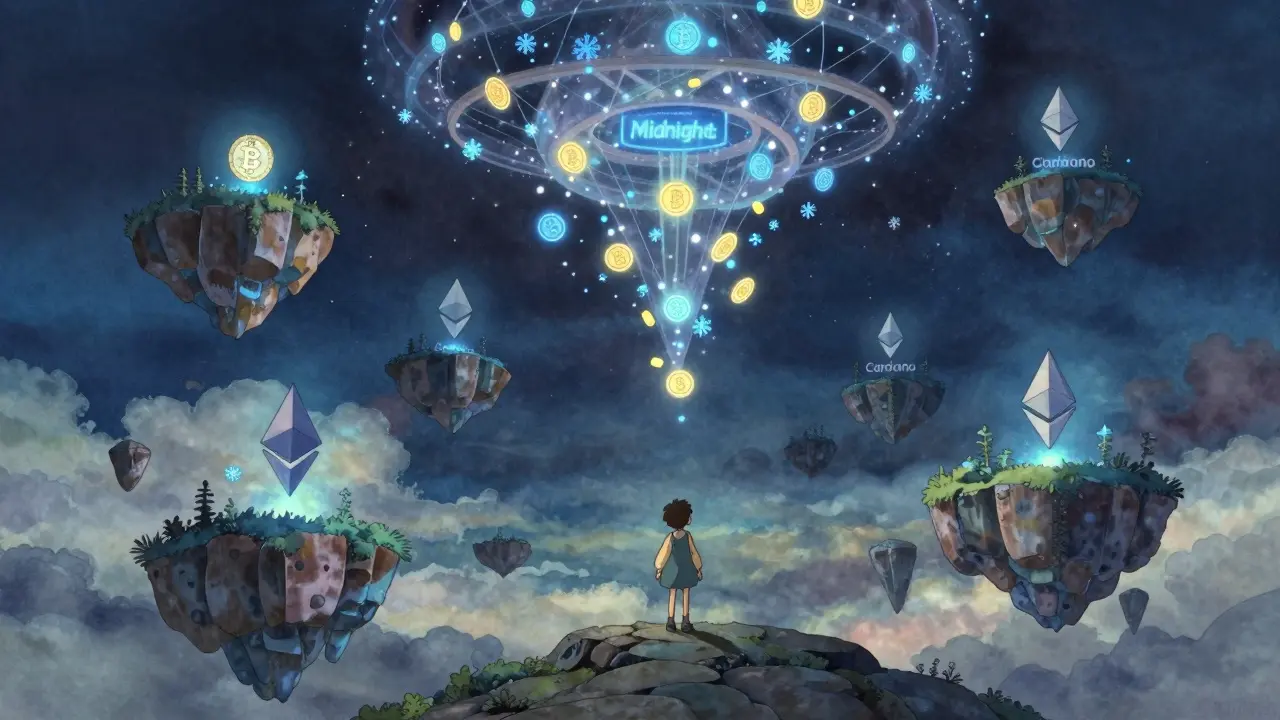
The drop distributed the entire genesis mint of 24 billion NIGHT tokens. These aren't just speculative assets; they are utility tokens intended for governance, staking, and securing the network. The distribution targeted holders across eight major blockchain networks:
- Bitcoin (BTC)
- Ethereum (ETH)
- Ripple (XRP)
- Solana (SOL)
- Avalanche (AVAX)
- BNB Chain (BNB)
- Brave (BAT)
- Cardano (ADA)
This cross-chain approach was rare. Most projects stick to their own ecosystem. By reaching out to these eight giants, Midnight aimed to create a diverse and robust user base from day one.
Eligibility Criteria: Who Qualified?
If you are wondering why you might have seen this news but didn't see a notification in your wallet, eligibility was strict and algorithmic. There was no social media following required, no points system to game, and no arbitrary tasks. The criteria were based purely on ownership at a specific moment in time.
The snapshot was taken on June 11, 2025. To qualify, your wallet had to hold at least $100 worth of cryptocurrency in the native asset of any supported chain at that exact timestamp. For example, if Bitcoin was trading at $50,000, you needed roughly 0.002 BTC. If Cardano was at $2.50, you needed about 40 ADA. This dollar-denominated threshold ensured that the distribution reached genuine retail participants while filtering out bot-created "dust" accounts.
Crucially, the allocation was weighted. Fifty percent of the total supply (12 billion tokens) was reserved exclusively for Cardano holders. This reflects Midnight's technical architecture as a sidechain of Cardano. Twenty percent went to Bitcoin holders, acknowledging BTC's status as the largest store of value. The remaining 30% was shared proportionally among holders of ETH, XRP, SOL, AVAX, BNB, and BAT based on the US-dollar value of their holdings.
One major exclusion applied: addresses flagged on the OFAC SDN list were automatically blocked. This compliance measure ensures the network remains usable in regulated jurisdictions, a key part of its "rational privacy" philosophy.
The Claiming Process: Why It Was Complex
The claiming window opened in July 2025 and ran for 60 days, closing on October 4, 2025. The process was designed to be secure, which meant it was also technically demanding for average users. You couldn't just connect a Coinbase account and click a button. The system required proof of self-custody.
To claim, users had to visit the official portal (midnight.gd or midnight.network) and perform two cryptographic proofs:
- Signature Proof: You had to sign a message with your private key to prove you controlled the wallet without moving funds. This prevented exchanges from claiming on behalf of users unless they explicitly chose to do so (which most didn't).
- Destination Address: You had to provide a fresh, unused Cardano wallet address to receive the NIGHT tokens.
This requirement created a significant friction point. Even if you held Bitcoin or Ethereum, you still needed a Cardano wallet to receive the tokens. Supported wallets included Eternl, Lace, Yoroi, and MetaMask (for bridging). For users unfamiliar with multi-chain interactions or digital signatures, this barrier was high. Community tutorials became essential, with many relying on video guides published in August 2025 to navigate the steps.
Vesting Schedule: No Immediate Liquidity
Even if you successfully claimed your tokens during the Glacier Drop, you couldn't sell them all immediately. Midnight implemented a sophisticated vesting schedule to prevent the typical "airdrop dump" where recipients sell instantly, crashing the price and destabilizing the network.
Claimed tokens are locked via a Cardano smart contract and unlock in four equal phases over a 360-day period. Here is how the "gradual thawing" works:
- Phase 1: 25% unlocks after 90 days from mainnet launch.
- Phase 2: 25% unlocks after 180 days.
- Phase 3: 25% unlocks after 270 days.
- Phase 4: Final 25% unlocks after 360 days.
Note that the countdown starts from the mainnet launch, not the date you claimed the tokens. Since the mainnet launch date has not been fixed with a precise calendar date yet, there is some uncertainty about when full liquidity will arrive. The unlock times within each 90-day window are also randomized to prevent coordinated selling events. This design forces participants to engage with the network-through block production, governance, or building applications using DUST (the fee token)-rather than treating NIGHT as a quick profit tool.
What Happens to Unclaimed Tokens?
This is the most critical question for those who missed the October 4 deadline. Your tokens didn't vanish into thin air, nor did they go back to the developers. They rolled over into the next phase of the distribution model.
The Midnight ecosystem uses a three-phase cascade:
- Glacier Drop: The initial 60-day claim window (Closed).
- Scavenger Mine: Unclaimed tokens enter this phase. Participants earn shares of the remaining allocation by solving public-good computational puzzles. This serves a dual purpose: distributing tokens to engaged community members and bootstrapping core network infrastructure through useful computation.
- Lost-and-Found: Any tokens surviving the Scavenger Mine become a bounty for final recovery opportunities after mainnet launch.
If you missed the Glacier Drop, you can still participate in the Scavenger Mine. This requires active engagement, essentially mining the unclaimed supply by contributing computational resources to the network. It shifts the dynamic from passive holding to active contribution.
Comparison: Midnight vs. Typical Airdrops
| Feature | Midnight Glacier Drop | Typical Crypto Airdrop |
|---|---|---|
| Total Supply Distributed | 24 Billion NIGHT tokens | Usually under 100 Million |
| Eligibility Basis | $100+ holdings on 8 chains (Snapshot) | Social media follows, testnet usage, or referral codes |
| Liquidity | Locked for 360 days (Vested) | Immediate liquidity upon claim |
| Cross-Chain Support | Yes (BTC, ETH, SOL, etc.) | No (Usually single-chain) |
| Unclaimed Token Fate | Recycled to Scavenger Mine | Burned or returned to treasury |
Key Takeaways for Users
The Midnight airdrop represents a shift in how privacy-focused blockchains bootstrap their communities. By prioritizing long-term vesting and cross-chain eligibility, the project aims to build a resilient network rather than a speculative pump. If you held eligible assets in June 2025, you likely qualified. If you didn't claim by October 4, you haven't lost your chance entirely, but you must now engage with the Scavenger Mine phase to access the remaining supply.
For those looking ahead, keep an eye on the mainnet launch announcement. That event triggers the vesting clocks for all claimed tokens. Until then, the focus remains on network security, testnet stability, and community education around the unique dual-token model of NIGHT and DUST.
Can I still claim my NIGHT tokens if I missed the October 4 deadline?
No, you cannot claim them through the original Glacier Drop portal. However, unclaimed tokens have moved to the "Scavenger Mine" phase. You can still earn a share of these tokens by participating in public-good computational puzzles that help seed the network infrastructure.
Why did I need a Cardano wallet to receive NIGHT tokens?
Midnight Network is a sidechain built on the Cardano ecosystem. Therefore, NIGHT tokens exist on the Cardano ledger. Even if you qualified by holding Bitcoin or Ethereum, the destination for the tokens must be a valid Cardano address to ensure compatibility with the network's smart contracts and privacy features.
When will my vested NIGHT tokens unlock?
The 360-day vesting schedule begins only after the Midnight mainnet launches. Tokens unlock in four equal phases every 90 days. Since the exact mainnet launch date is pending, the specific calendar dates for unlocking are not yet known. The unlocks are also randomized within each 90-day window to prevent market manipulation.
Was the Midnight airdrop safe from scams?
The official process required cryptographic signature proofs and excluded custodial exchange accounts, which significantly reduced the risk of Sybil attacks and bot farming. However, users always need to verify they are using the official domains (midnight.gd or midnight.network) and never share private keys. The project also enforced OFAC compliance to maintain regulatory safety.
What is the difference between NIGHT and DUST?
NIGHT is the utility and governance token used for voting and staking in the Midnight network. DUST is the resource token used to pay for transaction fees and computational costs. This dual-token model separates governance rights from operational costs, enhancing network sustainability.