
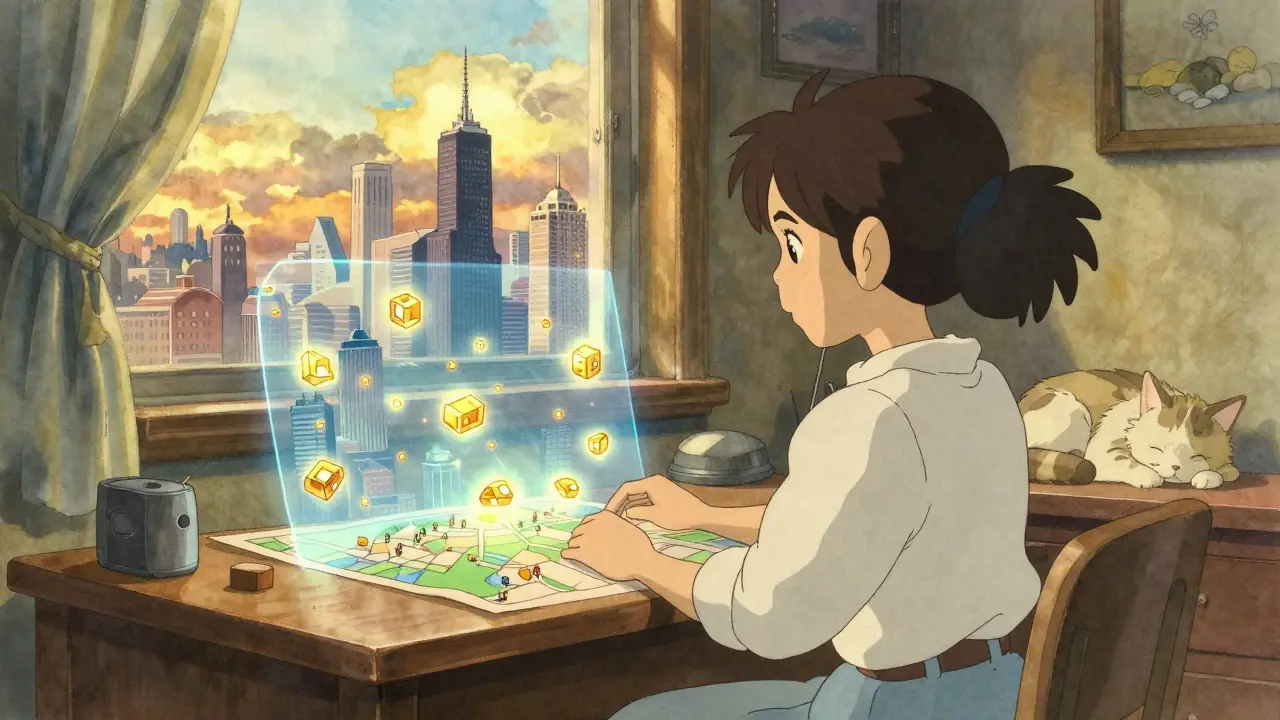
Imagine owning a piece of a skyscraper in downtown Chicago or a shopping mall in Sydney - not as a wealthy investor with millions to spend, but with just $1,000 in your digital wallet. That’s the reality real estate tokenization is making possible today. It’s not science fiction. It’s happening right now, and it’s changing how people invest in property around the world.
Real estate tokenization turns physical property into digital tokens on a blockchain. Each token represents a fraction of ownership in a building, land, or commercial complex. Instead of buying an entire apartment building, you buy 10 tokens that give you 0.1% ownership. These tokens can be bought, sold, and traded like stocks - but they’re backed by real bricks and mortar.
Why Real Estate Tokenization Matters
For decades, real estate has been one of the most reliable ways to build wealth. But it’s also one of the least accessible. To get into the market, you needed tens or hundreds of thousands of dollars. You had to deal with lawyers, notaries, banks, and months of paperwork. And once you bought it? You were stuck. Selling meant finding a buyer, negotiating, and waiting 60 to 90 days just to close.
Tokenization breaks all of that down. It removes the middlemen. It cuts costs. And it opens the door for everyday people to invest in high-value properties they could never afford before.
Key Benefits of Tokenized Real Estate
- Lower entry barriers - You don’t need $500,000 to buy a commercial property anymore. Platforms now offer tokens starting at $100-$1,000. In 2023, a $10 million office building in Miami was split into 10,000 tokens. Each one cost $1,000. That’s how small investors got in.
- Higher liquidity - Traditional real estate trades once a year, if you’re lucky. Tokenized property trades daily. Some platforms report transaction volumes up to 300% higher than traditional markets. You can sell your share in minutes, not months.
- Lower transaction costs - Buying property the old way? Expect to pay 5-10% in fees: agent commissions, title insurance, legal fees, transfer taxes. With tokenization, those fees drop to 1-3%. Smart contracts handle the paperwork automatically.
- Automated income - Rent payments, property income, or profits from resale? They’re sent directly to your digital wallet. No bank delays. No manual checks. One investor in Los Angeles received monthly payouts totaling 8.2% annual returns on their $5,000 token investment.
- Global access - You can invest in a Tokyo apartment, a Berlin warehouse, or a New York hotel without leaving your home. The blockchain doesn’t care where you live. Only that you pass KYC checks.
How It Works - Step by Step
It sounds complex, but the process is straightforward:
- A property owner or developer teams up with a tokenization platform. The property is legally owned by a Special Purpose Vehicle (SPV), which protects investors.
- A licensed appraiser values the property - say, $20 million.
- The SPV issues 20,000 tokens, each worth $1,000. These are security tokens, meaning they’re regulated like stocks, not cryptocurrencies.
- The tokens are listed on a compliant trading platform (like Securitize or Harbor).
- Investors buy tokens using fiat or crypto. Smart contracts handle ownership records on the blockchain.
- Income (rent, sales) is automatically distributed to token holders. No paperwork. No delays.
Everything is recorded on the blockchain. No one can alter it. No one can fake it. The history of every token transfer is public and permanent.

Where It’s Working - Real Examples
The Aspen St. Regis Resort in Colorado was one of the first major properties to tokenize in 2018, raising $18 million in equity. Since then, dozens more have followed.
In 2022, RealT tokenized a $22 million apartment complex in Los Angeles. They sold 1,247 individual tokens. The average investment? $17,650. Investors got monthly distributions and could sell their tokens anytime. Returns hit 11.3% annually - far above traditional rental yields.
Even big institutions are getting involved. J.P. Morgan launched its Onyx blockchain platform for commercial real estate in early 2023. BlackRock filed paperwork in August 2023 to launch a tokenized real estate fund. This isn’t just a fringe experiment anymore - it’s entering the mainstream.
Who’s Investing?
Five years ago, tokenized real estate was mostly for crypto enthusiasts. Today, it’s different. According to Chainlink’s 2023 data, nearly half of new investors come from traditional real estate backgrounds. They’re not crypto-savvy. They’re just looking for better returns, more flexibility, and lower barriers.
Investors range from:
- Single parents saving for retirement
- Small business owners looking to diversify
- Retirees seeking passive income
- International investors avoiding local property taxes
The average investor now holds between $5,000 and $50,000 in tokenized assets. That’s not a hedge fund. That’s someone trying to build wealth the smart way.

Challenges and Risks
It’s not all smooth sailing. Tokenization still faces real hurdles:
- Regulation - The U.S. has 50 different state laws on securities. The EU’s MiCA framework (effective June 2024) helps, but global consistency is still missing. In France, notarization is still required by law - no blockchain can change that.
- Smart contract risk - Bugs happen. Between 2017 and 2023, over $2.6 billion was lost due to coding errors in blockchain systems. Always use platforms with audited contracts.
- Limited trading options - There are only about 12 major platforms globally where you can trade real estate tokens. If yours isn’t listed, you might be stuck.
- Wallet security - Lose your private key? You lose your tokens. No customer service can recover them. Use hardware wallets. Never store keys online.
- Market correlation - Tokenized real estate doesn’t insulate you from market crashes. In 2022, when traditional property values dropped, tokenized ones dropped too. Professor Susan Athey from Stanford found an 87% correlation. It’s still real estate - just digital.
What’s Next?
The future is clear. Deloitte predicts that by 2027, 25% of commercial real estate deals over $50 million will involve tokenized components. Revenue sharing, automated tax reporting, and blockchain-based property records will become standard.
One of the biggest developments? Cross-chain interoperability. Chainlink’s CCIP protocol, launched in late 2023, lets tokens move between Ethereum, Polygon, Hedera, and other networks. That means you can buy on one platform and sell on another - no more locked-in systems.
And with 130 countries exploring central bank digital currencies (CBDCs), the next step is seamless integration: your government-issued digital dollar buys tokenized property, automatically, instantly, anywhere in the world.
Is It Right for You?
If you’re looking for:
- Passive income without managing tenants
- Exposure to high-value properties without buying outright
- Liquidity you can’t get from traditional real estate
- A way to diversify beyond stocks and crypto
Then tokenized real estate deserves a look. Start small. Invest $1,000. See how it works. Learn how to manage your wallet. Understand the regulations in your country.
It’s not a get-rich-quick scheme. It’s not a replacement for owning your home. But it’s a powerful new tool - one that’s finally making real estate investment fairer, faster, and more open than ever before.
What exactly is a real estate token?
A real estate token is a digital asset that represents fractional ownership in a physical property. Each token is recorded on a blockchain and gives the holder rights to a portion of the property’s value, rental income, or resale profit. Tokens are typically issued as security tokens, meaning they comply with financial regulations like SEC Rule D or EU MiCA.
Can I really invest with $1,000?
Yes. Many platforms now allow minimum investments as low as $100. For example, a $10 million commercial property might be divided into 10,000 tokens at $1,000 each. You can own 0.01% of a building with $1,000. This was impossible before tokenization.
Are tokenized real estate investments safe?
They’re safer than unregulated crypto, but not risk-free. The property itself must be legally structured through an SPV and appraised properly. Smart contracts must be audited. You need to use regulated platforms. The biggest risks are poor platform security, regulatory changes, and smart contract bugs. Always research before investing.
Do I need to be tech-savvy to invest?
You don’t need to be a developer, but you should understand basic blockchain concepts: wallets, private keys, and how to transfer tokens. Most platforms offer user-friendly apps similar to stock trading apps. If you can use PayPal or Robinhood, you can handle tokenized real estate. The learning curve is about 15-20 hours for most beginners.
Can I sell my tokens anytime?
Most platforms allow daily trading, unlike traditional real estate, which takes months to sell. However, liquidity depends on the platform and the property. Popular assets like office buildings or apartment complexes in major cities have active markets. Smaller or niche properties may have fewer buyers. Always check the secondary trading volume before investing.
Is real estate tokenization legal?
It’s legal in many countries - including the U.S., EU, Singapore, and Switzerland - as long as it follows securities laws. In the U.S., issuers must comply with SEC regulations like Regulation D, S, or A+. In the EU, MiCA (effective June 2024) provides clear rules. But in places like France or Japan, legal barriers still exist. Always check local regulations before investing.
What happens if the platform shuts down?
Your tokens are stored on the blockchain, not on the platform. Even if the platform goes offline, you still own your tokens. You can move them to another wallet or use a different exchange that supports the same token standard. Always use a non-custodial wallet (like MetaMask or Ledger) for full control.
How are taxes handled?
Tax rules vary by country. In the U.S., tokenized real estate is treated like stocks or mutual funds. Capital gains apply when you sell. Rental income is taxable as ordinary income. Some platforms provide tax reports, but you’re responsible for filing. International investors face complex cross-border tax rules - consult a tax professional familiar with digital assets.




Tobias Wriedt
March 17, 2026 AT 09:49Bro, this is literally the future 🚀✨ I bought my first $1,000 token last month - a tiny slice of a Miami condo - and got my first rent payout in ETH last week. No landlord. No repairs. Just money dropping into my wallet like clockwork. 🤑💸
Ernestine La Baronne Orange
March 19, 2026 AT 00:49This is so dangerous!! I mean, really?? You’re telling me we’re just going to let some tech bros with smart contracts replace centuries of real estate law?? Who’s auditing these SPVs?? Who’s guaranteeing the property value?? And what happens when the blockchain crashes?? Or the platform gets hacked?? Or the SEC comes knocking?? This isn’t innovation - it’s financial roulette with a glittery UI!! I’ve seen this movie before - 2008, 2017, 2021 - and every time, the little guy gets wiped out while the VCs cash out. I’m not mad… I’m just disappointed. 😭
Manali Sovani
March 19, 2026 AT 07:07The concept is theoretically intriguing. However, the operational feasibility remains questionable due to regulatory fragmentation and the absence of standardized legal frameworks across jurisdictions. Furthermore, the reliance upon blockchain infrastructure introduces systemic vulnerabilities which may not be adequately mitigated by current technological paradigms. A more prudent approach would involve incremental pilot programs under supervised financial authorities.
Konakuze Christopher
March 21, 2026 AT 05:17S F
March 23, 2026 AT 04:10Who let this happen?? America’s housing market is already broken - now we’re letting foreigners buy fractions of our buildings with crypto? This is national security risk number one. We need to ban this NOW before China buys half of Texas.
Angelica Stovall
March 23, 2026 AT 14:13Let me guess - you’re one of those people who thinks ‘blockchain’ = ‘magic money printer’. You don’t even know what an SPV is. You just saw a YouTube ad and thought ‘I’m rich now’. Wake up. You’re not an investor. You’re a data point. And your $1,000? It’s just fuel for their next IPO.
Taylor Holloman.
March 24, 2026 AT 14:01I’ve been watching this space for years… and honestly? It’s messy. But not hopeless. There’s real potential here - if we slow down, build real safeguards, and stop treating this like a TikTok trend. I’ve got a friend who’s a retired teacher with $8K in tokenized rentals. She’s getting $60/month. It’s not life-changing… but it’s steady. And for her? That’s everything. Maybe we need to stop shouting ‘revolution’ and start building ‘reliable systems’.
Bryan Roth
March 25, 2026 AT 01:18Hey, I’m not a tech guy - I run a small plumbing business. But I put $5K into a tokenized apartment in Detroit last year. Got my first check in March. $120. Not a fortune - but I used it to fix my truck. No one’s handing me a gold-plated yacht. But I’m building something real. And I’m proud of it. If you’re scared? Start small. Learn. Don’t let fear silence your next move. You’ve got this.
Prakash Patel
March 25, 2026 AT 04:46Actually, most tokenized real estate is overvalued. The rental yields are inflated by cherry-picked examples. The average return is closer to 4.5%, not 8-11%. And the liquidity? Most tokens trade once a month. The hype is real. The reality? Not so much.
Robert Kunze
March 26, 2026 AT 17:48wait so if i lose my phone i lose my house?? like… what?? i just bought 3 tokens and now i’m terrified. my wallet is on my phone and i have like 17 apps on there… i think i’m gonna cry. help??
Heather James
March 28, 2026 AT 10:24Smart contracts can’t replace human judgment. But they can automate the boring stuff. I like that. Just don’t forget: property still needs maintenance, tenants still need empathy, and markets still crash. Tech is a tool - not a savior.
Carol Lueneburg
March 30, 2026 AT 10:00I’m so proud of us!! 🥹💖 This is what inclusion looks like - a single mom in Ohio, a retiree in Florida, a student in Manila - all owning a piece of the same building. It’s not perfect… but it’s beautiful. Keep going. We’re rewriting the rules - one token at a time. 💪✨